
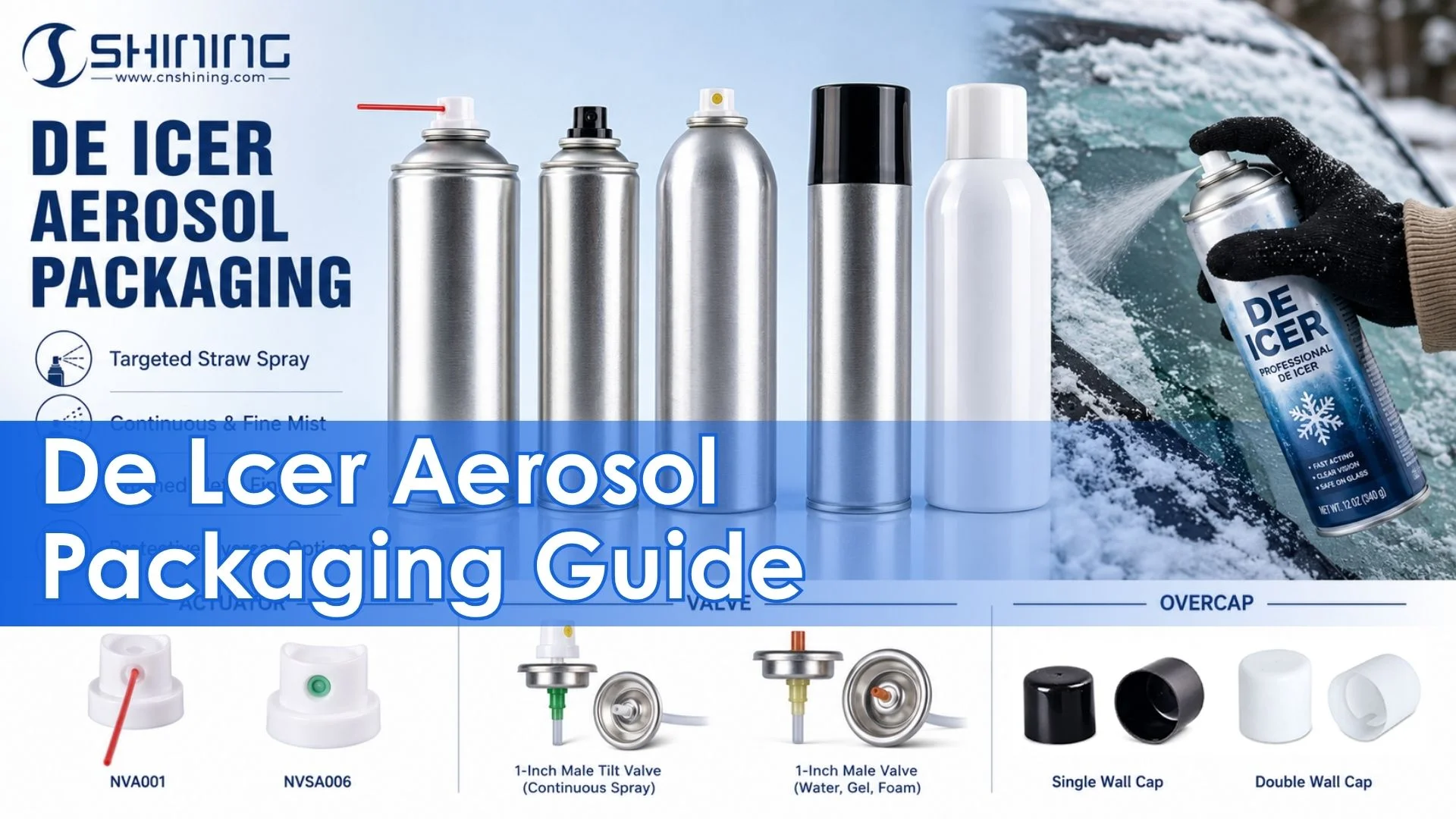
Ice does not need to be melted completely before a driver can move. It needs to lose its grip on glass fast. That is the working logic behind aerosol de icer, also called aerosol windshield de-icer, car window de-icer spray, windscreen defroster spray or lock de-icer in adjacent use cases.
This category looks simple from the shelf. The engineering is not simple. A useful product must lower the freezing point, wet the ice-glass interface, spray at low temperature, avoid excessive residue and stay sealed inside a pressurized alcohol-compatible package. Most complaints are not about “chemistry” alone. They are about the whole package system.
1. What Aerosol De Icer Really Is
In this article, aerosol de icer means a consumer winter spray mainly used on front windshields, side windows, rear windows, mirrors, wiper blades, lock cylinders and door locks. The core package is a metal aerosol can. The core formula logic is an alcohol-based freezing-point depression system.
When comparing market size and alternatives, liquid trigger-spray de-icers are included as a neighboring category because they compete directly with aerosol products at retail. Solid road de-icers and vehicle heating systems are treated as functional alternatives, not as direct product equivalents.
Public market data is inconsistent. One narrow-market report places the global car windscreen de-icer spray market at about USD 99 million in 2024 and USD 128 million by 2034. The same page states a 3.6% CAGR, but the two endpoints imply roughly 2.6%. Broader “automotive de-icer spray” reports often move into the USD 1.2-1.5 billion range, likely because they include trigger sprays, winter glass care, washer fluids, anti-fog products or adjacent winter maintenance items.
Practical conclusion: aerosol de icer is a slow-growth winter maintenance product, not a high-explosion category. The real product battle is not only the liquid formula. It is valve sealing, spray pattern, can coating, low-temperature discharge and user tolerance for odor or residue.
2. Product Boundary and Working Mechanism
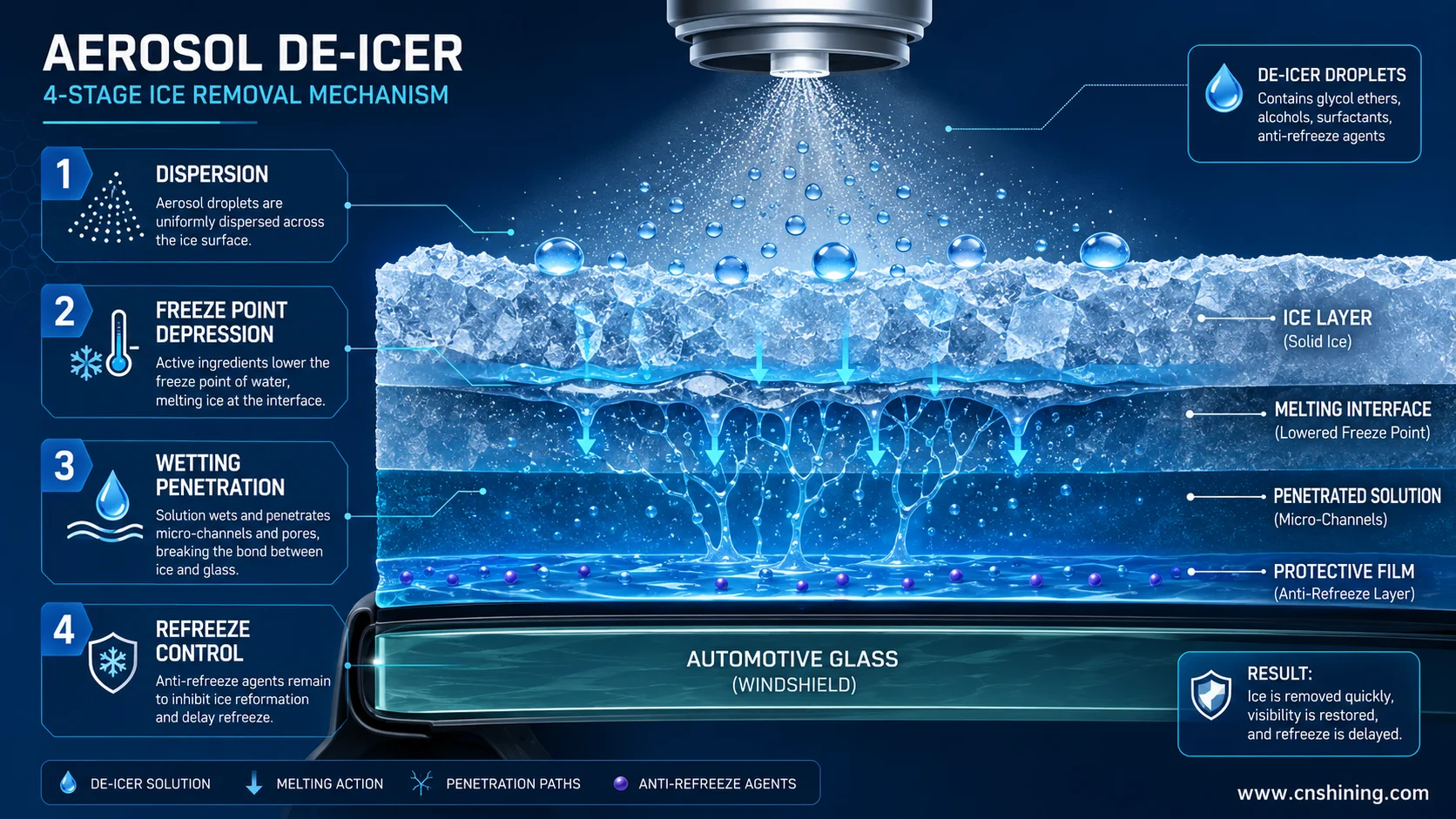
Commercially, consumers understand this product as “spray it on icy glass, wait a few seconds to tens of seconds, then clear the loosened frost with less scraping.” That description is accurate enough, but it misses the engineering sequence.
2.1 Physical dispersion
The aerosol can uses propellant pressure, valve geometry and an actuator to distribute liquid across an ice layer. The valve and actuator influence spray rate, particle size and spray behavior; aerosol component data from Shining aerosol technical material shows how stem and housing orifices change spray characteristics. For windshield use, this matters because users often spray from a low angle, in wind, or with the can partially inverted.
2.2 Freezing-point depression
Alcohols and glycols lower the freezing point of the water phase and break the bond between ice and glass. Methanol, ethanol and isopropanol have long been used for this reason. The methanol-water freezing point curve shows why methanol has been attractive in older and high-performance formulations.
2.3 Wetting and penetration
Good de-icing is not just “more alcohol.” The liquid has to spread into the ice-glass interface. The classic US3245912A windshield de-icing composition patent describes soluble surfactants as a way to improve wetting and reduce streaking after wiper use. That old lesson still applies.
2.4 Refreeze control and material care
Glycol, propylene glycol or glycerine-type additives can help reduce refreeze tendency and improve rubber feel. They are not always the main ice-melting component. Their role is closer to after-performance: less drying, less harsh wiping, less hardening of rubber contact parts.
3. Market Size, Growth and Regional Split
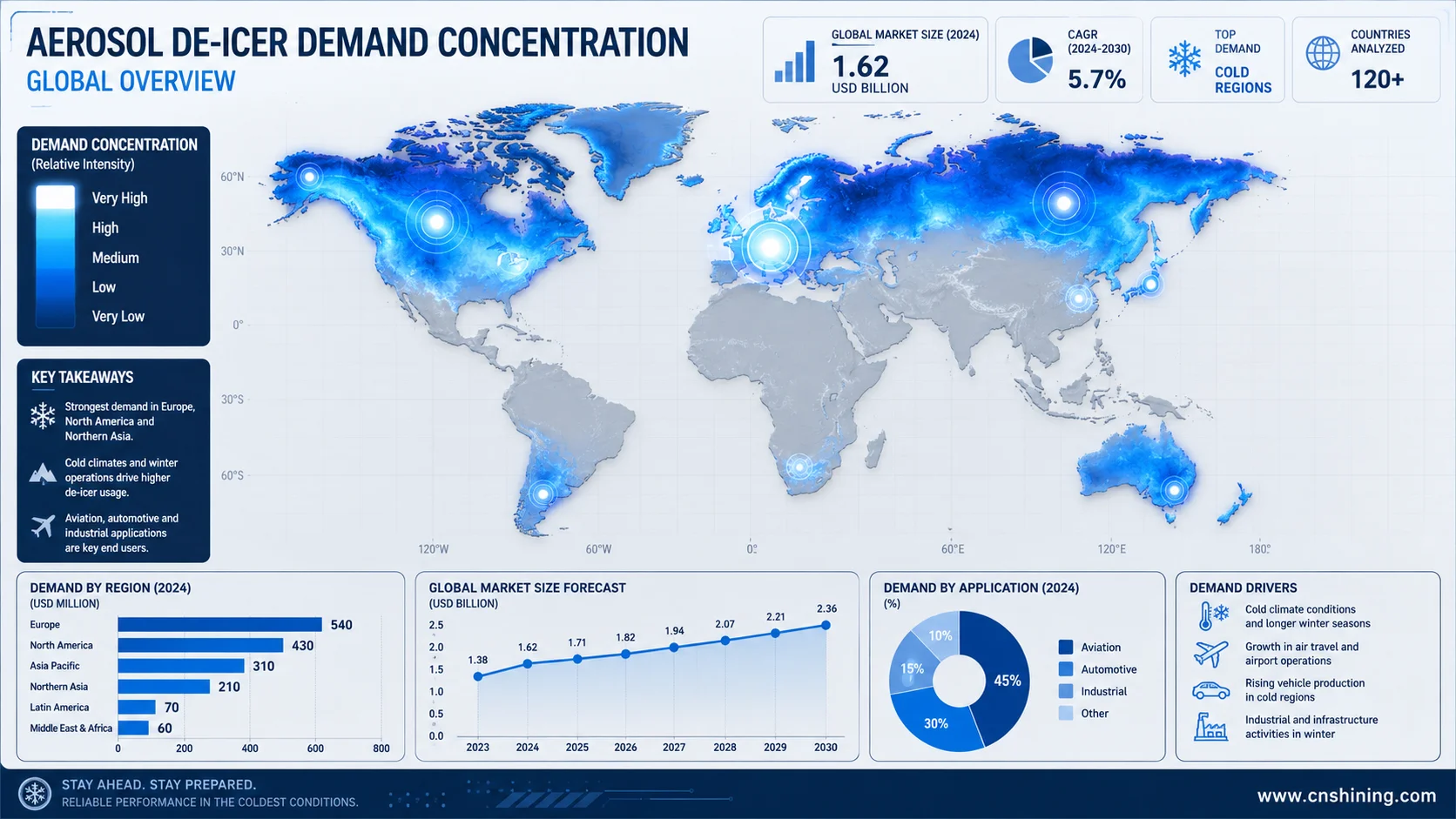
The first question is not “how large is the market?” The first question is “what is being counted?” Public sources mix at least three scopes:
| Scope | Public Value | Technical Reading |
|---|---|---|
| Narrow: car windscreen de-icer spray | About USD 99 million in 2024; about USD 128 million in 2034 | Closest to consumer windshield de-icer spray. The stated CAGR and endpoint math are not fully aligned. |
| Medium: automotive de-icer spray | Often around USD 1.5 billion level | Likely includes aerosol, trigger spray, additives and some winter glass-care products. |
| Broad: windscreen de-icer / winter glass care | Often around USD 1.2 billion and above | Useful as a total addressable market signal, but not clean for aerosol can planning. |
Using the narrow scope, a practical baseline can be rebuilt from the 2024 and 2034 endpoints. That gives a slow-growth sequence for 2023-2033:
| Year | Estimated Core Market Size |
|---|---|
| 2023 | USD 96.5 million |
| 2024 | USD 99.0 million |
| 2025 | USD 101.6 million |
| 2026 | USD 104.2 million |
| 2027 | USD 106.9 million |
| 2028 | USD 109.7 million |
| 2029 | USD 112.6 million |
| 2030 | USD 115.5 million |
| 2031 | USD 118.5 million |
| 2032 | USD 121.6 million |
| 2033 | USD 124.8 million |
Europe and North America remain the revenue core. This is supported by vehicle stock and winter use logic: the EU has a large passenger car fleet according to ACEA vehicle parc data; Canada reported 26.8 million road motor vehicles in 2024; and the United States maintains a very large vehicle registration base through FHWA Highway Statistics.
| Region | 2024 Estimated Size | Reasoning |
|---|---|---|
| Europe | USD 34.6 million | Mature winter car-care retail, strong SKU variety, low-methanol and methanol-free direction. |
| North America | USD 31.7 million | High car dependency and harsh winter states/provinces. Stronger tolerance for high-performance solvent routes. |
| Asia Pacific | USD 22.8 million | Smaller than Europe and North America, but northern China, Japan, Korea and cross-border e-commerce support demand. |
| Other regions | USD 9.9 million | Mostly high-latitude, high-altitude, imported or seasonal niche demand. |
The purchase frequency is not determined by global car stock alone. The real equation is simpler: cold-region private car density × outdoor parking share × winter commuting pressure.
4. Alternatives, Segments and Terminology
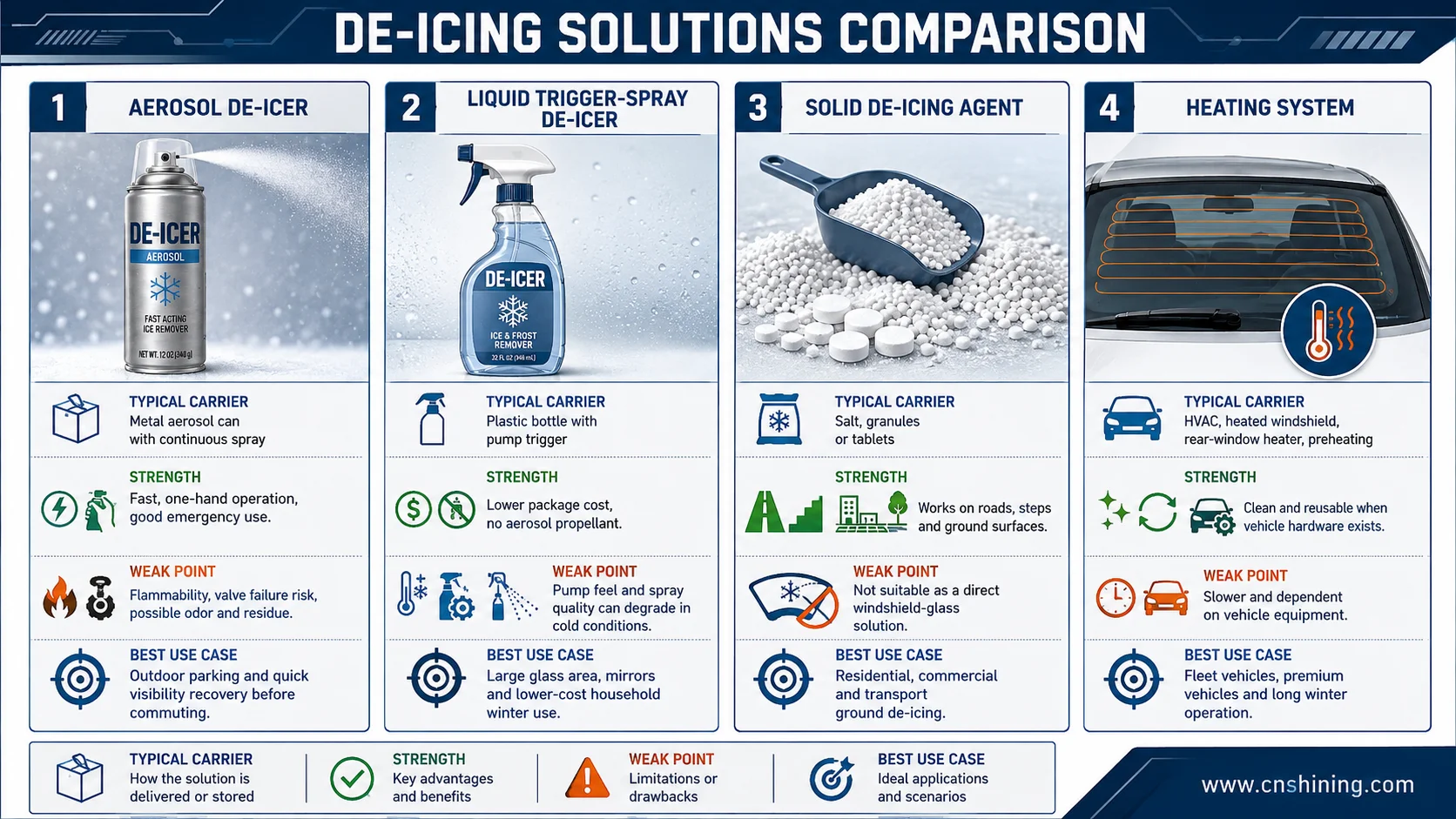
| Solution | Typical Carrier | Strength | Weak Point | Best Use Case |
|---|---|---|---|---|
| Aerosol de icer | Metal aerosol can with continuous spray | Fast, one-hand operation, good emergency use. | Flammability, valve failure risk, possible odor and residue. | Outdoor parking and quick visibility recovery before commuting. |
| Liquid trigger-spray de-icer | Plastic bottle with pump trigger | Lower package cost, no aerosol propellant. | Pump feel and spray quality can degrade in cold conditions. | Large glass area, mirrors and lower-cost household winter use. |
| Solid de-icing agent | Salt, granules or tablets | Works on roads, steps and ground surfaces. | Not suitable as a direct windshield-glass solution. | Residential, commercial and transport ground de-icing. |
| Heating system | HVAC, heated windshield, rear-window heater, preheating | Clean and reusable when vehicle hardware exists. | Slower and dependent on vehicle equipment. | Fleet vehicles, premium vehicles and long winter operation. |
The aerosol format is rarely the cheapest option. It often wins because it needs fewer actions. A driver can stand outside the car, spray the windshield edge, mirror and lock, then scrape less. That convenience is the reason the format still survives despite heated windows and washer-fluid solutions.
4.1 Key product segments
- By formula: traditional methanol systems, low-methanol transition systems, methanol-free ethanol/glycol systems and high-water/high-flash-point routes.
- By application: windshield, side window, rear window, mirror, wiper blade, lock and latch.
- By channel: automotive specialty retail, mass retail, e-commerce, private label and OEM filling.
4.2 Useful terminology
| Term | Meaning | Why It Matters |
|---|---|---|
| Freeze-point depression | Lowering the freezing point through alcohols or other solutes. | Controls how fast ice starts to loosen. |
| Refreeze | Water re-freezes after first melting. | A common source of poor field experience. |
| Wetting agent | Surfactant that improves spreading and penetration. | Affects streaks, patchy melting and wiping behavior. |
| Actuator | The button/nozzle pressed by the user. | Controls spray pattern, feel and clogging risk. |
| 360° valve | Valve that sprays upright, sideways or inverted. | Useful for windshield lower edges, mirrors and locks. |
| Stem gasket swell | Dimensional change of rubber valve gasket in contact with formulation. | Directly related to leakage and spray failure. |
| Inner lacquer | Internal can coating. | Protects metal from alcohol/glycol corrosion and contamination. |
| UN1950 | Common transport classification for aerosols. | Influences storage, shipping and e-commerce routing. |
5. Formulation Systems, Safety and Patent Routes
Public SDS documents and patents show that the market does not follow one formula template. The table below is better treated as a formulation map than a precise bill of materials.
| Formula Type | Typical Components | Public Range / Evidence | Safety Note |
|---|---|---|---|
| Traditional methanol aerosol | Methanol, ethanol, LPG propellant, minor surfactant or amine. | Older UK SDS shows methanol 5-10%, ethanol 5-10%, butane/isobutane 1-5% each in a standard -20°C de-icer SDS. | Methanol creates acute toxicity and STOT concerns. Whole can remains extremely flammable. |
| Low-methanol transition aerosol | Ethanol, ethylene glycol, low methanol, LPG, IPA, trace ammonia. | A low methanol aerosol de-icer SDS lists ethanol 10-30%, ethanediol 5-10%, butane/isobutane 1-5%, methanol below 0.6% and IPA below 1%. | Reduces methanol regulatory pressure but remains a flammable aerosol. |
| Methanol-free ethanol/glycol aerosol | Ethanol, ethanediol, LPG and small IPA. | A Tetrosyl methanol-free aerosol SDS shows ethanol and glycol as the visible structure. | More consumer-friendly in Europe, but still requires flammability labeling and storage control. |
| Mixed private-label route | Ethanol, glycol, IPA, methanol, butane/propane. | Blue Star-style private-label SDS history includes mixed alcohol and propellant structures; one example is the Tetrosyl de-icer SDS. | Flexible for OEM and private label, but regional compliance becomes harder. |
| High-water / high-flash-point concept | Water, methanol, propylene glycol and surfactant. | US5932529A describes windshield washer fluids with high water content and a flash point above 100°F. | Interesting for logistics and B2B handling, not always fastest for retail aerosol use. |
| Ether / alcohol / water aerosol route | Propylene glycol methyl ether, alcohol and water. | US3705854A shows another solvent architecture for de-icer composition. | Solvent odor, cost and regulatory fit need separate review. |
Methanol is technically attractive because it is inexpensive and has strong freezing-point depression. It is also a regulatory and toxicology problem. OSHA’s chemical database lists methanol hazards under methyl alcohol chemical data. In practice, methanol has not disappeared. It has become a regionally sensitive ingredient.
Patent literature also shows where the experience upgrades come from. US20030197150A1 explores alternative de-icing compositions, while US9856442 links windshield washer preparation with process and packaging considerations. The signal is clear: formula, propellant and package design should be developed together.
6. Regulations That Shape the Formula
Regulation is not a back-office issue for this product. It defines the formula direction, label, SDS, shipping route and sometimes the package choice.
| Market | Main Rules | Direct Product Impact |
|---|---|---|
| United States | CPSC FHSA, OSHA HCS, 16 CFR Part 1500 and 49 CFR 173.306. | Strong performance formulas are still possible, but warning language, workplace SDS and aerosol transport limits must be handled correctly. |
| European Union | CLP Regulation 1272/2008, REACH SDS requirements, Aerosol Dispensers Directive and the EU methanol restriction. | The methanol limit of 0.6% in windscreen washing or defrosting fluids pushes the market toward low-methanol or methanol-free systems. |
| Canada | Hazardous Products Regulations, WHMIS, TDG and aerosol container requirements. | Bilingual hazard communication and transport classification need early planning. |
| Australia | AICIS, Safe Work Australia SDS/GHS guidance and ADG Code. | Importer obligations, workplace labels, SDS and dangerous-goods routing must match the exact formulation. |
The United States behaves more like a “label and transport discipline” market. The EU behaves more like a “formula first” market because the methanol restriction changes the active solvent route. China, Canada and Australia each have different procedures, but the shared lesson is the same: one formula and one label file rarely sell cleanly worldwide.
7. Top 10 Aerosol De Icer Brands and Price Signals
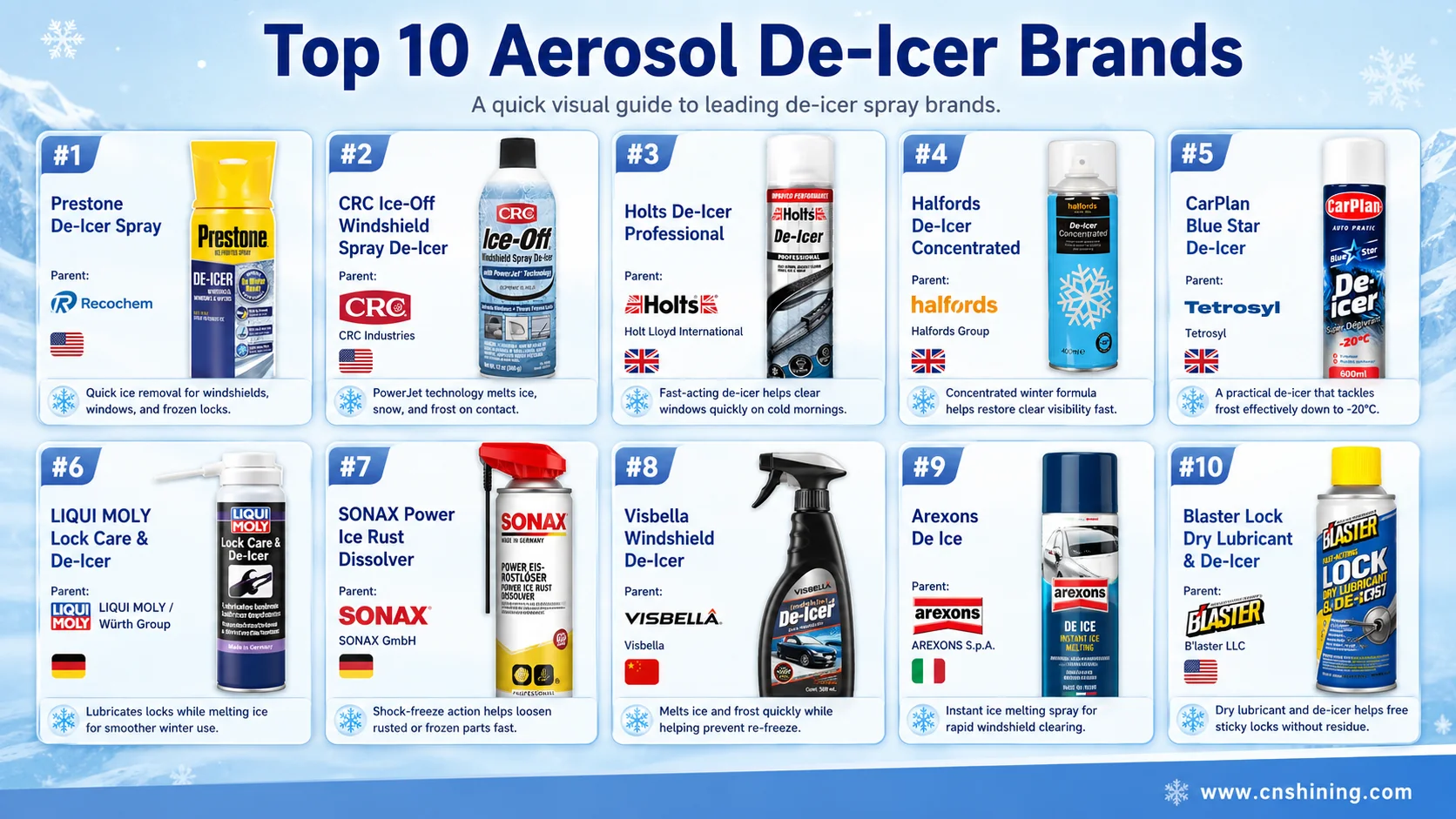
| Brand | Country | Parent / Operator | Typical Capacity | Typical Price Range | Technical Reading |
|---|---|---|---|---|---|
| Prestone | United States | Prestone Products Corporation | 11 oz / 17 oz / 32 oz | about $4-10 | Mass North American benchmark. Strong performance language, but methanol-route labeling pressure is higher. |
| CRC Ice-Off | United States | CRC Industries | 12 wt oz | about $4.5-6 | More tool-like positioning. Power-jet logic fits thick ice and frozen lock scenarios. |
| Holts | United Kingdom | Holt Lloyd International | 600 ml | about $5-6 | Simple UK winter maintenance language: fast clearing, reduced smearing and familiar retail trust. |
| Halfords | United Kingdom | Halfords Group plc | 400 ml / 600 ml | about $5-6 | Retail channel itself is the advantage. Strong understanding of seasonal shelf behavior. |
| CarPlan Blue Star | United Kingdom | Tetrosyl | 500 ml / 600 ml | about $4-5 | Value-oriented UK route. Private-label and OEM logic are visible. |
| LIQUI MOLY | Germany | LIQUI MOLY GmbH | 500 ml | about $9-10 | More chemical-company than impulse winter product. Rational maintenance positioning. |
| SONAX | Germany | SONAX GmbH | 500 ml / 750 ml / 1 L | about $10-15 | Experience upgrade route: rubber care, lower scraping burden and residue control. |
| Visbella | China | Visbella | About 500 ml class | about $8-15 | Cross-border e-commerce route. Claims can be strong, but trust depends heavily on user reviews. |
| Arexons | Italy | Arexons S.p.A. | 400-500 ml class | about $5-8 | Part of a broader car-care portfolio rather than a single winter hero SKU. |
| Blaster / Lock De-Icer | United States | Blaster Holdings | 3 oz lock format | about $4-7 | Not a windshield main product, but very relevant for lock cylinder and door hardware freezing. |
The useful lesson from the brand table is not “who is most expensive.” Price is tied to package type, regulation, retail structure and trust. North American single units can be cheaper. UK and German specialty retail can support higher-margin winter SKUs. Cross-border e-commerce can write aggressive parameters, but spray failure, odor or residue will show up quickly in reviews.
8. User Pain Points and Packaging Engineering
Consumer complaints are repetitive. That is useful. Repeated complaints usually point to engineering variables that can be tested.
| Pain Point | Likely Package Cause | Engineering Action |
|---|---|---|
| No spray / poor spray | Stem gasket swelling or shrinkage, actuator blockage, poor propellant-liquid balance. | Run valve compatibility tests before artwork approval. Do not assume a universal gasket exists. |
| Sprays as a narrow line | Actuator not designed for windshield coverage. | Use a wide-fan actuator for glass. Reserve power-jet or straw logic for locks. |
| Hard to spray lower windshield edge | Standard upright valve loses performance when can angle changes. | Use 360° / up-down valve technology for premium or professional versions. |
| Used up too quickly | Flow rate too high, fan width too narrow, user repeats passes. | Adjust spray width and give simple use-distance instructions, such as 30 cm and one top-down pass. |
| Residue, haze or smeary film | Formula balance, droplet size and over-application all contribute. | Use medium atomization with even fan coverage. Do not chase ultra-fine mist blindly. |
| Leakage | Gasket incompatibility, crimp variation, valve/cup seal instability. | Test gasket swell using FEA 641 gasket test logic. |
| Can corrosion or shelf instability | Alcohol/glycol system not compatible with metal or internal coating. | Use internal coating and run 50°C accelerated compatibility checks. |
Aerosol valve training material from Aerosol Valves 101 makes the same point in plain terms: the stem gasket seals the valve, rubber can shrink or swell with different formulations, and there is no universal stem gasket. This is one of the most practical statements in the whole category.
9. Packaging BOM for a Reliable Aerosol De Icer
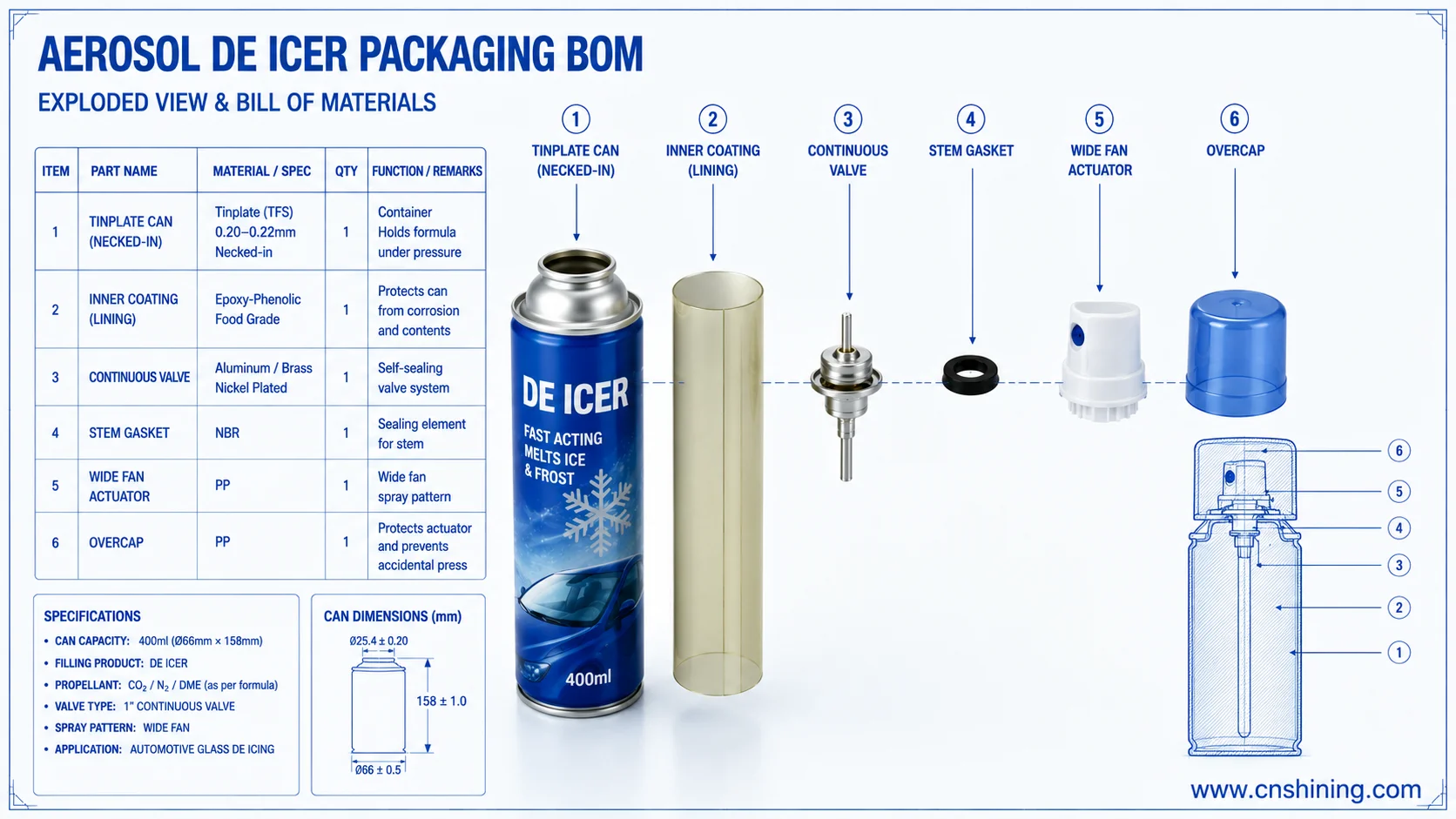
For a mainstream aerosol de icer designed for European or North American retail, the recommended structure is straightforward.
9.1 Can body
A cost-focused mainstream SKU can use a necked-in tinplate aerosol can around the 45 mm body class. It is mature, scalable and shelf-friendly. A premium line can move to an aluminium monobloc can for appearance and corrosion safety margin, but cost rises.
9.2 Valve and gasket
Use a 1-inch continuous valve for windshield coverage. Screen stem gasket materials such as Buna-N, chlorobutyl or butyl against the exact formula and propellant. For higher-risk formulas, stainless steel spring options such as 316 SS may be worth evaluating.
9.3 Actuator
The actuator should fit the use case. A windshield product needs broad, even coverage. A lock product needs focused delivery. One actuator cannot serve both well. For winter users, a larger glove-friendly actuator surface is more useful than a small decorative button.
9.4 Internal coating
Alcohol and glycol systems should not be assumed safe in bare metal. Epoxy-phenolic or BPA-NI epoxy systems are common starting points for stronger solvent packages. Polyester may be evaluated for lower methanol-pressure systems, but accelerated aging is still required.
9.5 Label and overcap
The front label should show the low-temperature claim, use area and spray instruction quickly. The back label must handle flammable aerosol language, eye warning, storage temperature, disposal and transport-relevant details. A protective overcap should prevent accidental discharge in shipment and car storage.
10. Shining Packaging: Actuators, Aerosol Cans and Valves for This Category
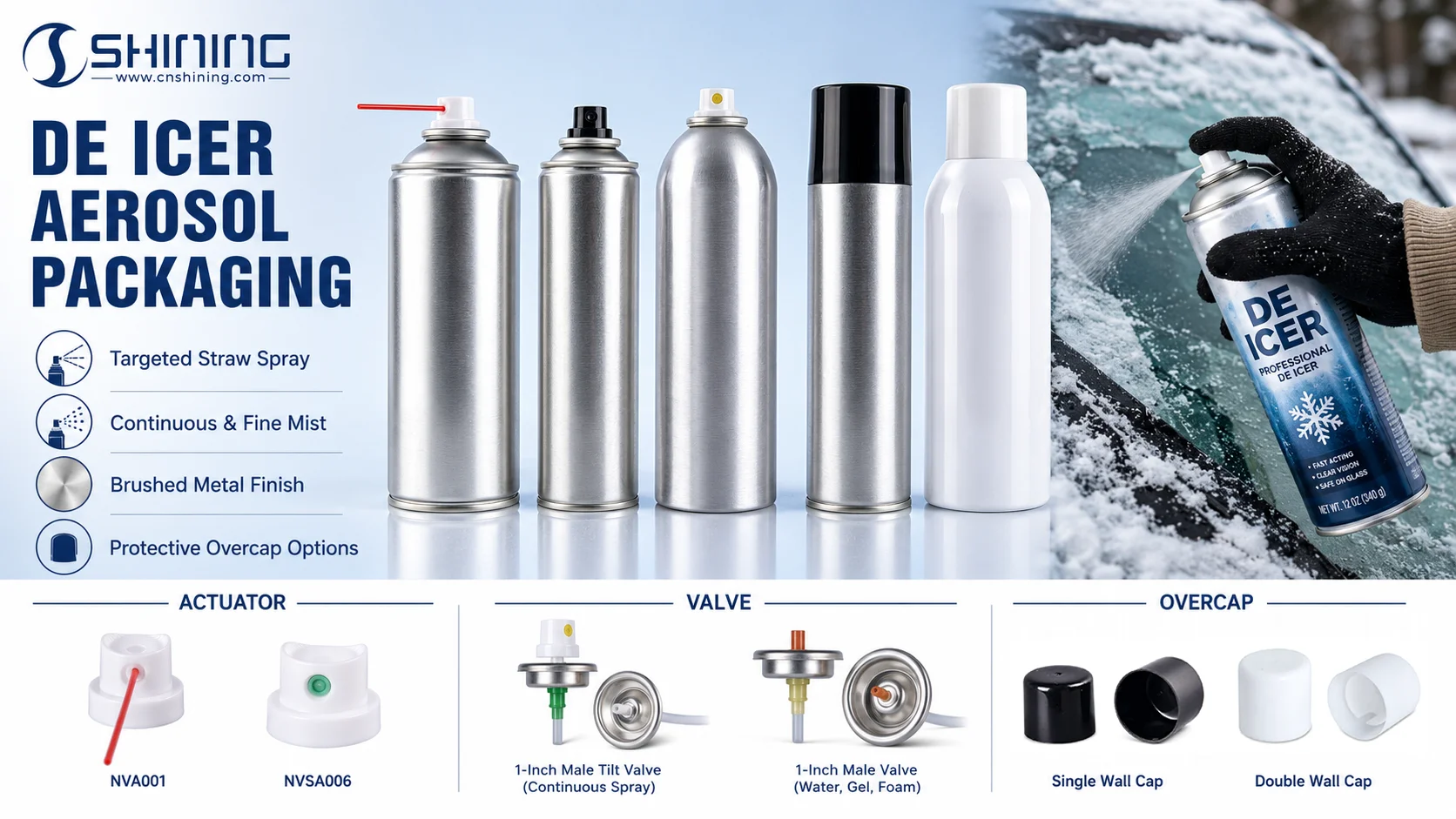
For aerosol de icer, Shining Packaging’s role is not to decide the solvent system. The practical focus is the package: metal aerosol can, actuator and valve compatibility. This is where many winter-use failures begin.
A de-icer package should be reviewed from the liquid outward. Alcohol/glycol compatibility affects the inner coating. Propellant selection affects low-temperature pressure and spray feel. Valve gasket material affects leakage and “no spray” complaints. The actuator decides whether the product covers a windshield as a fan or wastes material as a narrow line.
For can selection, Shining Packaging steel aerosol can options are relevant when the project needs a cost-stable metal format for winter automotive aerosol products. The can should still be tested with the exact formula, coating, valve and storage condition. In this category, compatibility testing is not paperwork. It is product development.
11. Technology Trends and Resource Index
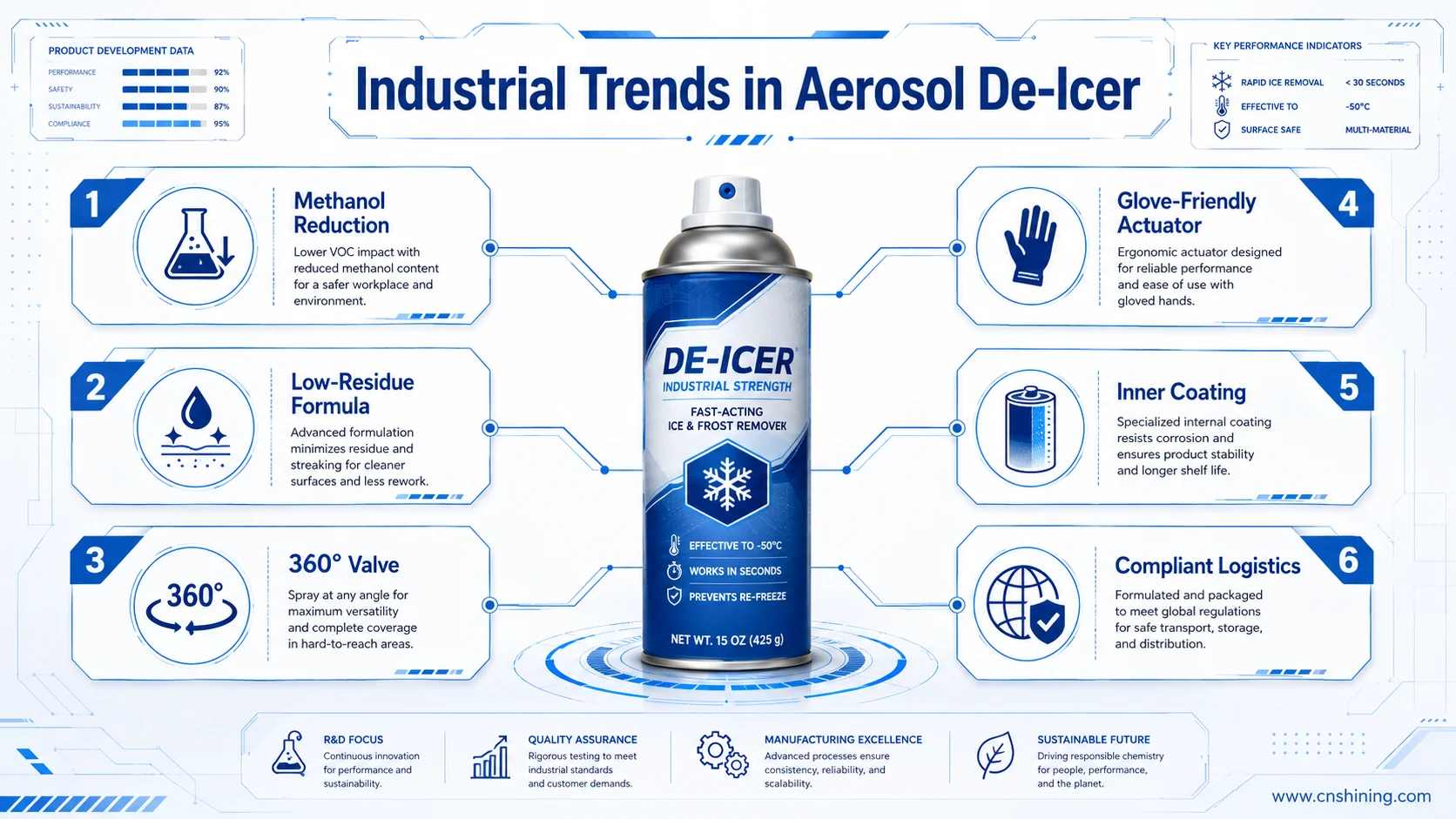
11.1 Methanol is losing its default position
The EU methanol limit has already pushed European products toward low-methanol and methanol-free systems. The global market will not converge into one formula. It will split by regulatory region, toxicity tolerance, shipping method and performance requirement.
11.2 Experience upgrades matter more than headline temperature claims
A -40°C claim looks strong on the label. It does not automatically solve residue, smell, overspray, rubber drying or refreeze. Mid-to-high-end products will increasingly compete on lower haze, lower odor, better wetting and more controlled spray volume.
11.3 Packaging engineering is becoming visible
360° valves, wide-fan actuators, lockable caps, better gasket screening and stronger inner coatings are not decorative features. They answer real complaints. The useful technical resources include FEA aerosol standards for aerosol testing and dimensional control.
11.4 Channels are polarizing
Large retailers push reliability and logistics. E-commerce pushes search terms, small packs and bold claims. The risk is clear: a product can win the search page and lose the review page if the spray head, odor or low-temperature discharge is weak.
12. Practical Conclusion
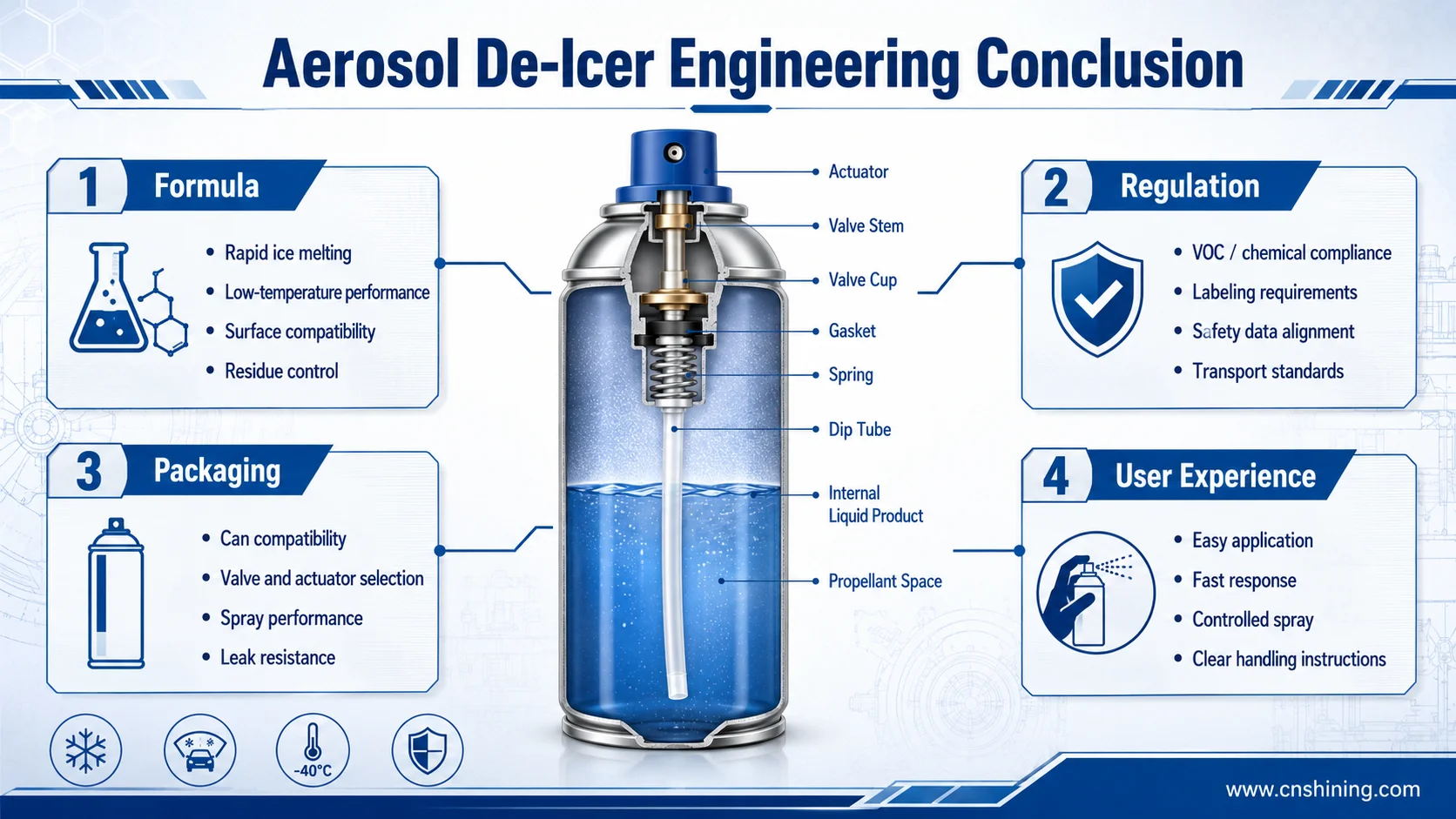
For packaging development, the conclusion is sharper: aerosol de icer is not won by adding more chemical claims. It is won by building a stable winter-use system. The package must spray under cold conditions, resist alcohol attack, seal through storage, deliver the right fan pattern and avoid residue complaints. A few percentage points of formula change cannot compensate for a leaking valve or a narrow actuator.
For a new SKU, start with the target market regulation, then define the solvent system, then test can coating, gasket, valve and actuator as one package. That sequence saves time. It also prevents the most common failure: a formula that works in a beaker but fails in the user’s hand.
13. FAQ: Technical Questions About Aerosol De Icer
An aerosol de icer is used to loosen ice, frost and light frozen layers on automotive glass and nearby parts. Typical use areas include windshields, side windows, rear windows, mirrors, wiper blades and frozen locks. Its job is not deep cleaning. The practical target is fast visibility recovery with less scraping and fewer manual steps in cold weather.
It works through several actions at the same time. The aerosol system spreads the liquid over the ice. Alcohols lower the freezing point and weaken the ice-glass bond. Wetting agents help the liquid move into the interface. Glycol or glycerine-type additives can help reduce refreezing and improve the feel of rubber contact parts after wiping.
Methanol is effective and inexpensive, but it carries higher toxicity concerns. The EU restricts methanol in windscreen washing and defrosting fluids to 0.6%, so European products often use low-methanol or methanol-free ethanol/glycol systems. Some non-EU markets still tolerate stronger methanol routes where performance claims and cost pressure are given more weight.
The common causes are package-related. Alcohol and glycol systems can make rubber stem gaskets swell or shrink. The actuator can clog or be poorly matched to the formula. Propellant pressure may also drop in cold storage. A successful product needs formula, propellant, gasket, valve and actuator testing together, not separate component approval only.
Aerosol de icer usually gives faster and more convenient application because the package provides continuous pressurized spray. It is useful for emergency use and outdoor parking. Trigger-spray products can be cheaper and avoid aerosol propellant, but pump feel and spray quality can drop in low temperature. The better choice depends on use frequency, climate and cost target.
Glycol and glycerine-type materials are not always the main melting agents. Alcohols usually handle most of the rapid freezing-point depression. Glycols and glycerine can support refreeze control, surface lubrication, rubber feel and wipe quality. Too much residue-forming material can also create haze or smear, so the formula must balance melting speed with final glass clarity.
The actuator decides how the liquid reaches the glass. A windshield product needs wide, even fan coverage so the user can cover a large area without repeated passes. A narrow jet may look powerful but waste product and leave untreated areas. Lock de-icers are different; they often need a focused jet or straw-style delivery into a small opening.
Residue can come from formula imbalance, surfactant choice, glycol level, over-application or poor droplet control. Very fine mist is not always better, especially in wind. A medium atomization fan can give more controlled coverage. Thick ice should be mechanically broken or scored first, then sprayed, rather than solved only by excessive chemical dosage.
Key tests include formula stability, freezing behavior, spray rate at low temperature, actuator spray pattern, valve leakage, gasket swell, can coating compatibility and accelerated storage. The test pack should use the final liquid, propellant, valve, gasket, actuator and can. Changing any one of these parts can change leakage, spray feel or shelf stability.
Users judge aerosol de icer in a stressful moment: cold morning, frozen glass and limited time. If the product leaks, smells harsh, sprays as a line, empties too fast or leaves haze, the chemical claim no longer matters. Packaging determines how the formula is delivered. In this category, delivery reliability is part of product performance.
14. Reference Links Retained from Source Material
Retail purchase links, social media discussion links and weak brand-only purchase links were not retained in the article body. The technical and regulatory links below are kept once only.
- Automotive De-Icer Spray market broad-scope reference
- Automotive de-icer spray market scope reference
- Automotive de-icer spray regional trend reference
- De-icing agent market trend reference
- Internal coating of aerosol cans technical reference