
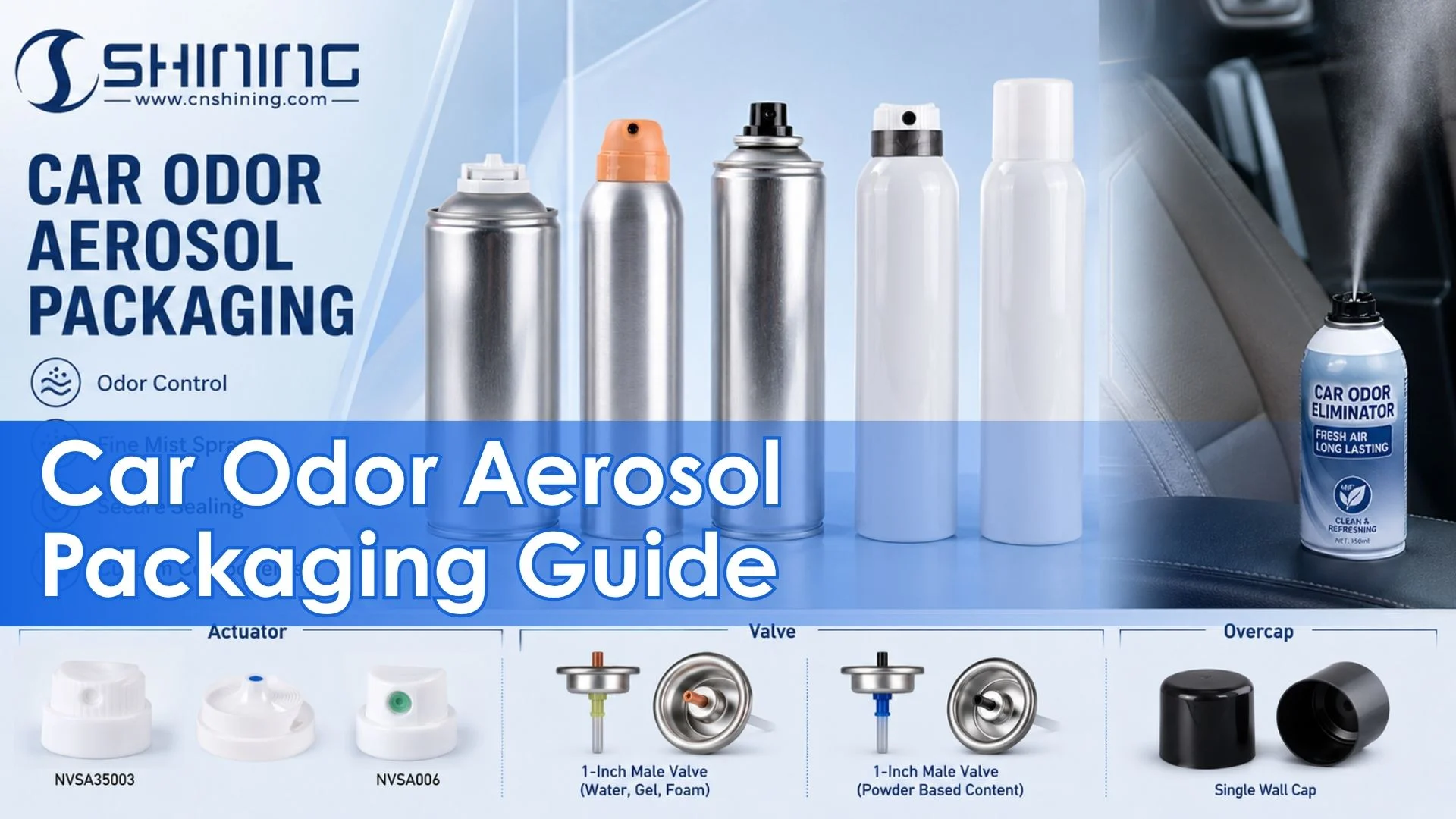
A car odor aerosol spray is not just fragrance in a small can. It is a pressurized packaging and release system that uses a container, propellant, valve and actuator to deliver a liquid formulation as controlled droplets into a car cabin.
That makes this product category different from hanging car air fresheners, gel cans or pump sprays. A car interior is a small, warm, enclosed space with plastics, fabrics, foam, carpets and HVAC ducts. If the spray pattern, dose or odor-control chemistry is poorly matched, the result is predictable: a strong first smell, possible irritation, and a user complaint that the product “replaced” the odor rather than removed it.
The technical question is simple: can the product reduce smoke, pet, food, mildew or HVAC odor without overloading the cabin with solvent and fragrance? The answer depends on formulation, VOC compliance, packaging compatibility, valve performance, actuator spray pattern and user instructions.
1. What Defines a Car Odor Aerosol Spray?
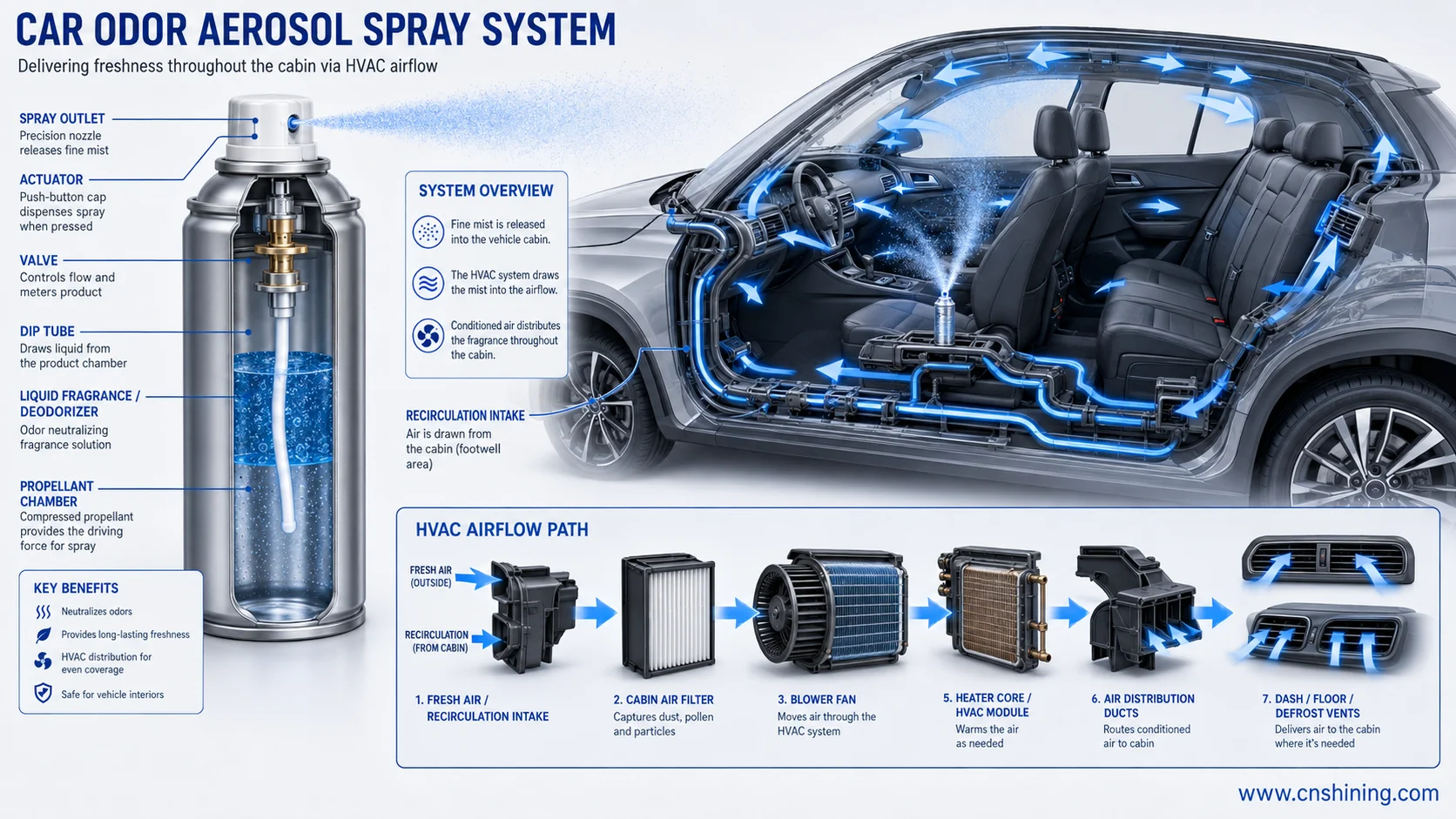
Regulatory definitions are consistent across major markets. An aerosol dispenser is generally a non-refillable pressurized container fitted with a release device and containing compressed, liquefied or dissolved gas. The EU Aerosol Dispenser Directive describes the container, actuator, valve, propellant and active product as a single system, not separate accessories. The U.S. definition in 49 CFR 171.8 also focuses on non-reusable containers, pressurized gas and a self-closing release mechanism.
For car odor treatment, three product formats are common:
- Manual continuous aerosol spray: used for mats, seats, fabric and spot treatment.
- Metered aerosol spray: used when dose control matters and over-spraying must be limited.
- Total-release fogger / one-shot fogger: activated once inside the cabin while HVAC recirculation distributes droplets through the whole interior.
Whole-car foggers usually require HVAC recirculation, closed doors and windows, about 10–15 minutes of treatment time, and then 5–15 minutes of ventilation. This operating window matters. The product is not only judged by the first smell. It is judged by whether the cabin is usable after the ventilation step.
2. Odor Control Mechanisms: More Than Masking
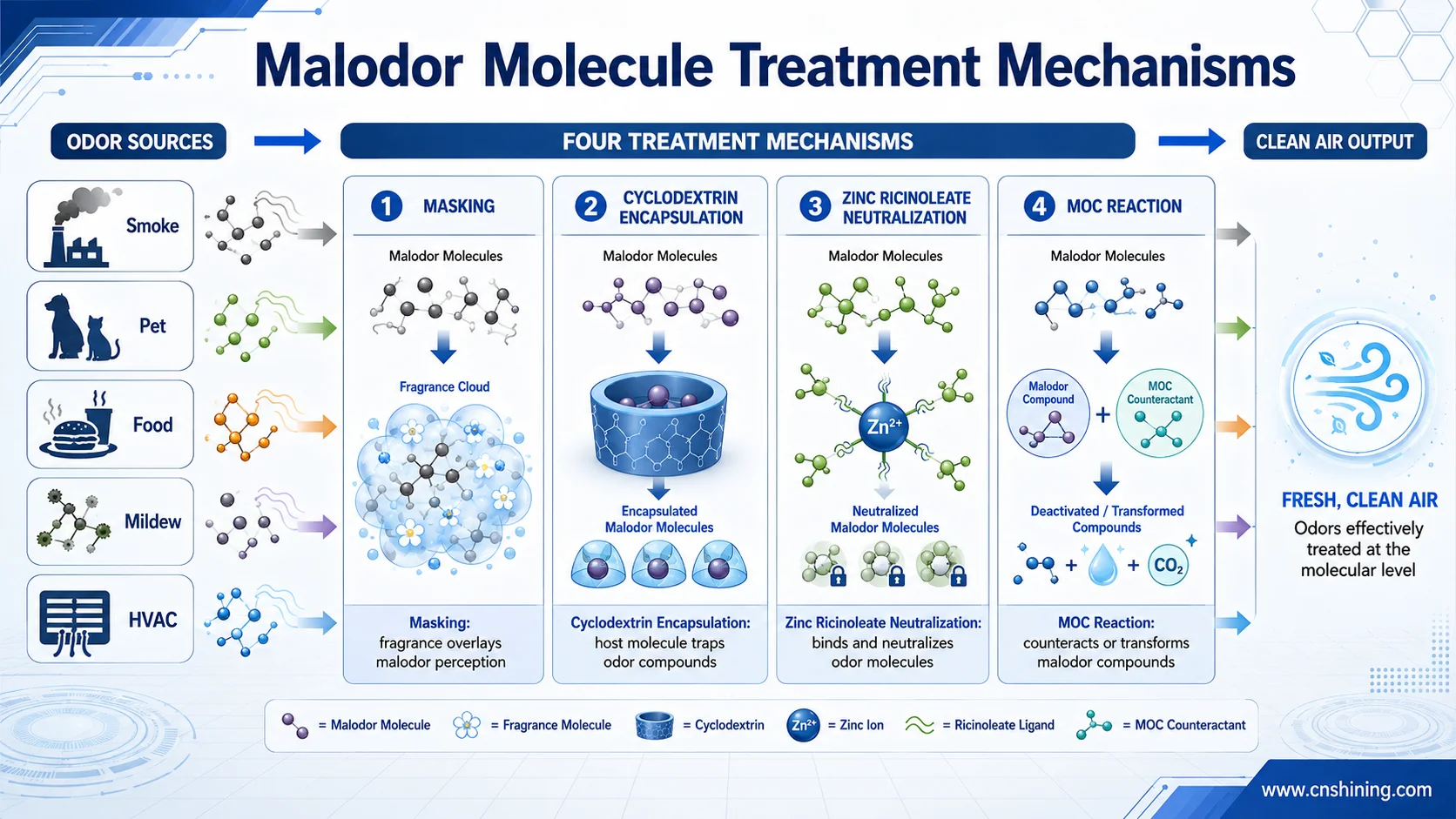
Car odor aerosol spray should not be treated as simple scent coverage. Public patents, labels and technical literature show at least five odor-control routes:
| Mechanism | Typical Technical Route | Practical Meaning in a Car Cabin |
|---|---|---|
| Masking | Fragrance and low odor-threshold perfume materials | Fast first impression, but high risk of “too strong” feedback |
| Complexation / Encapsulation | Cyclodextrin systems | Can trap selected odor molecules before they reach the nose |
| Neutralization / Coordination | Zinc ricinoleate, betaine, amino alcohol systems | Useful for sulfur and amine-type malodors, but solubility is difficult |
| Reactive MOC | Malodor counteractants using selected aldehydes, ketones or ionic materials | Can reduce odor perception at low dosage, but patent space is dense |
| Biological / Enzyme Story | Active enzyme claims, more common in liquid sprays | Useful as a product story, but aerosol compatibility needs proof |
Commercial products often combine routes. A practical formula may use fragrance + solvent or water + propellant + one or more odor-neutralizing actives. The Ozium EPA label, for example, discloses 4.4% triethylene glycol and 4.4% propylene glycol as active ingredients. That does not mean every automotive odor spray should follow this exact route. It means label-backed claims and actual formulation chemistry must be aligned.
Odor persistence is still tied to the source. Wet seats, mildew growth, smoke residue and evaporator contamination can keep generating odor. In these cases, an aerosol can improve cabin perception, but it cannot replace cleaning, drying or HVAC service.
3. Product Boundary: Aerosol Spray Is Not Every Car Air Freshener
A common mistake is to group all car fragrance products under one label. That creates regulatory and engineering confusion. A non-aerosol spray, a gel air freshener, a vent clip and a pressurized total-release fogger are not the same product class.
Regulators may separate air fresheners into single-phase aerosol, double-phase aerosol, pump spray, solid and semi-solid formats. Transport rules, VOC limits, flammability statements and pressure safety testing are different. A team entering this category should define the product by release system first, then by odor claim and fragrance profile.
Useful primary references for the definition layer include the EU Aerosol Dispenser Directive and 49 CFR 171.8 aerosol definitions.
4. Competitive Comparison: Where Aerosol Foggers Fit
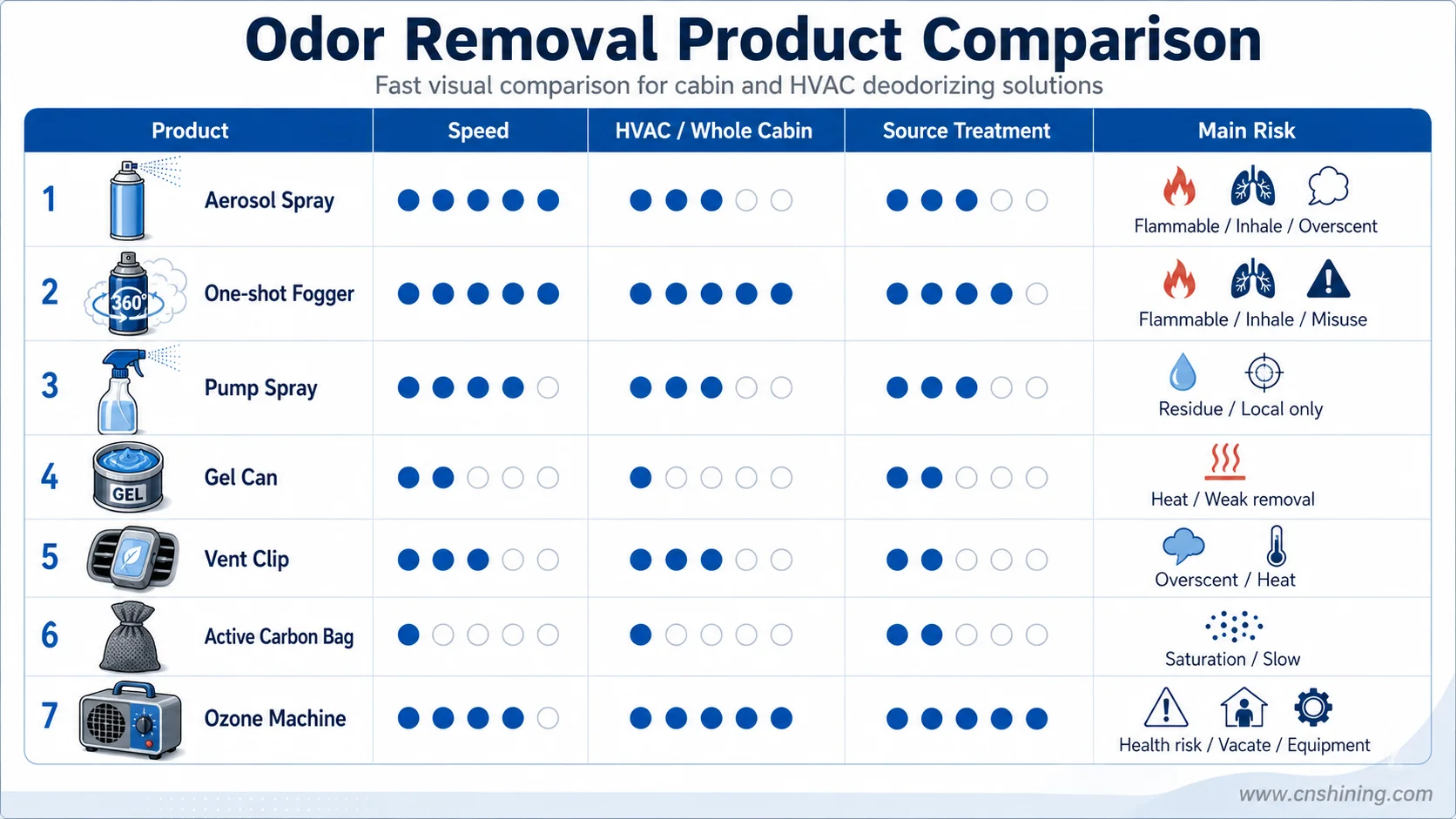
Car odor aerosol spray competes with gel cans, solid air fresheners, liquid trigger sprays, ozone machines and activated carbon bags. The real difference is not whether the cabin smells pleasant for a few minutes. The real difference is coverage, source treatment, residue, safety risk and repeat-use logic.
| Solution | Speed | HVAC / Whole Cabin Coverage | Source Treatment | Main Risk |
|---|---|---|---|---|
| Aerosol spray / one-shot fogger | Fast | Strong, especially with recirculation | Medium to strong, formula-dependent | Flammability, inhalation, over-scenting, misuse |
| Solid deodorizer / gel can | Slow | Weak | Weak to medium | Heat instability, weak source removal |
| Liquid trigger spray | Fast | Medium, mostly local | Formula-dependent | Wet residue, poor duct reach |
| Ozone machine | Medium to strong | Strong | Strong under controlled conditions | Health risk, equipment need, strict vacancy requirement |
| Activated carbon bag | Slow | Weak | Passive adsorption | Saturation, slow response |
The U.S. EPA takes a cautious position on ozone generators used as air cleaners in occupied spaces. That matters for automotive odor work. Ozone can be effective under professional controls, but it is not the same use case as a consumer aerosol fogger. For passive adsorption, activated carbon can help maintain air quality, but saturation limits must be accepted.
Aerosol foggers have a clear strength: they can reach the cabin quickly and carry droplets through air movement. Their weakness is also clear: if the fragrance or solvent note is too heavy, the whole cabin receives the mistake.
5. Top 10 Car Odor Aerosol Spray Brands
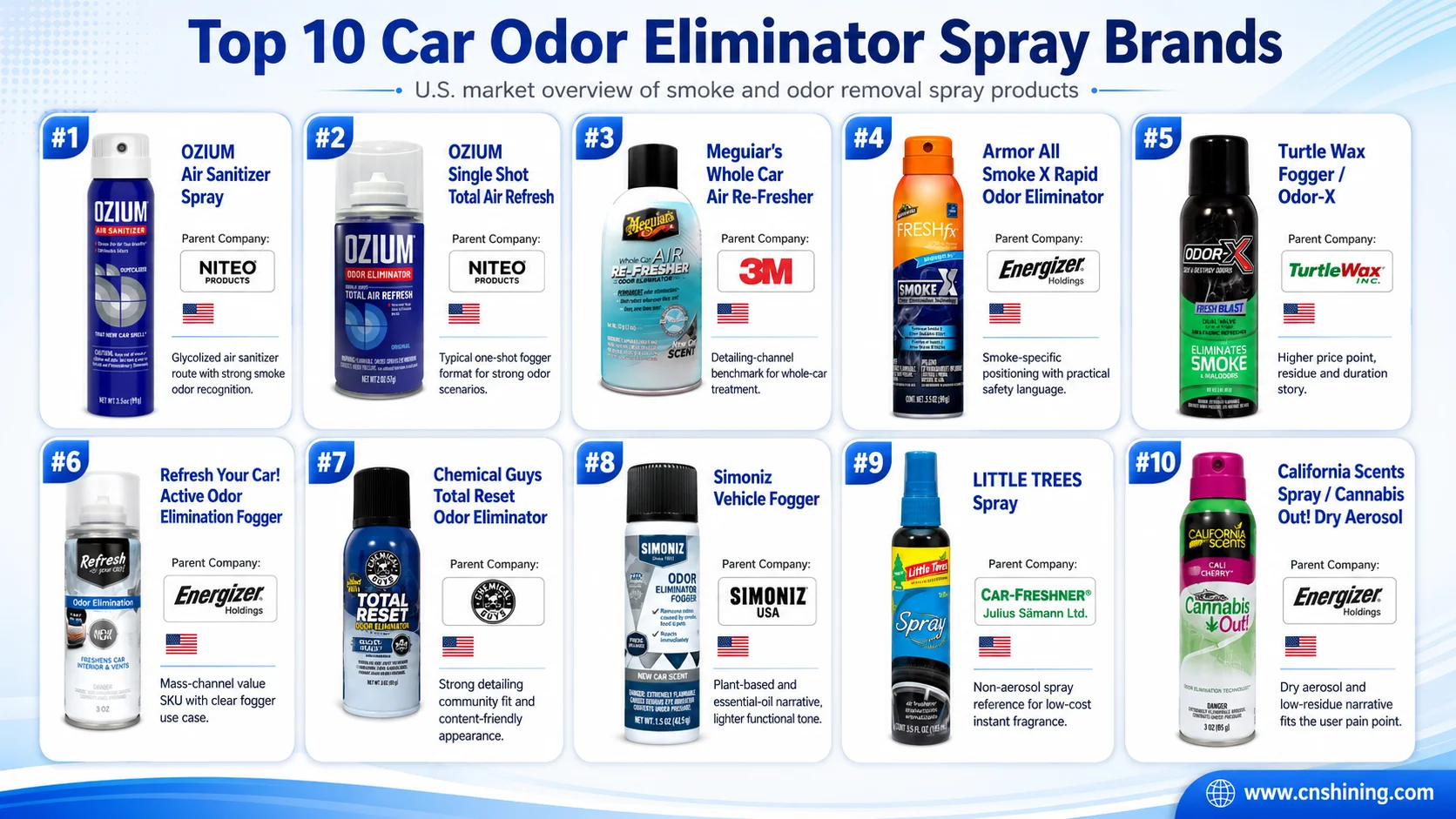
| Brand / Series | Region | Company | Common Size | Visible Price Range | Technical Comment |
|---|---|---|---|---|---|
| OZIUM Air Sanitizer Spray | U.S. | Niteo Products | 0.8 / 3.5 / 8 oz | about $3.99-6.99 | Glycolized air sanitizer route with strong smoke odor recognition |
| OZIUM Single Shot Total Air Refresh | U.S. | Niteo Products | 2 oz | about $6.97-7.99 | Typical one-shot fogger format for strong odor scenarios |
| Meguiar’s Whole Car Air Re-Fresher | U.S. | 3M | 2 oz | about $7.97-12.75 | Detailing-channel benchmark for whole-car treatment |
| Armor All Smoke X Rapid Odor Eliminator | U.S. | Energizer Holdings | 2 oz | about $6.76-6.97 | Smoke-specific positioning with practical safety language |
| Turtle Wax Fogger / Odor-X | U.S. | Turtle Wax Inc. | 2 oz | about $11.10-12.43 | Higher price point, residue and duration story |
| Refresh Your Car! Active Odor Elimination Fogger | U.S. | Energizer Holdings | 3 oz | about $5.64 | Mass-channel value SKU with clear fogger use case |
| Chemical Guys Total Reset Odor Eliminator | U.S. | Chemical Guys | 3 oz fogger; 4 / 16 / 32 oz spray | about $5.99-9.99 | Strong detailing community fit and content-friendly appearance |
| Simoniz Vehicle Fogger | U.S. | Simoniz USA | 1.5 oz | about $5.97 | Plant-based and essential-oil narrative, lighter functional tone |
| LITTLE TREES Spray | U.S. | CAR-FRESHNER / Julius Sämann Ltd. | 3.5 fl oz | about $2.97 | Non-aerosol spray reference for low-cost instant fragrance |
| California Scents Spray / Cannabis Out! Dry Aerosol | U.S. | Energizer Holdings | Spray / dry aerosol | about $4.99-11.48 | Dry aerosol and low-residue narrative fits the user pain point |
6. Formula Structure, Terms and Safety Points
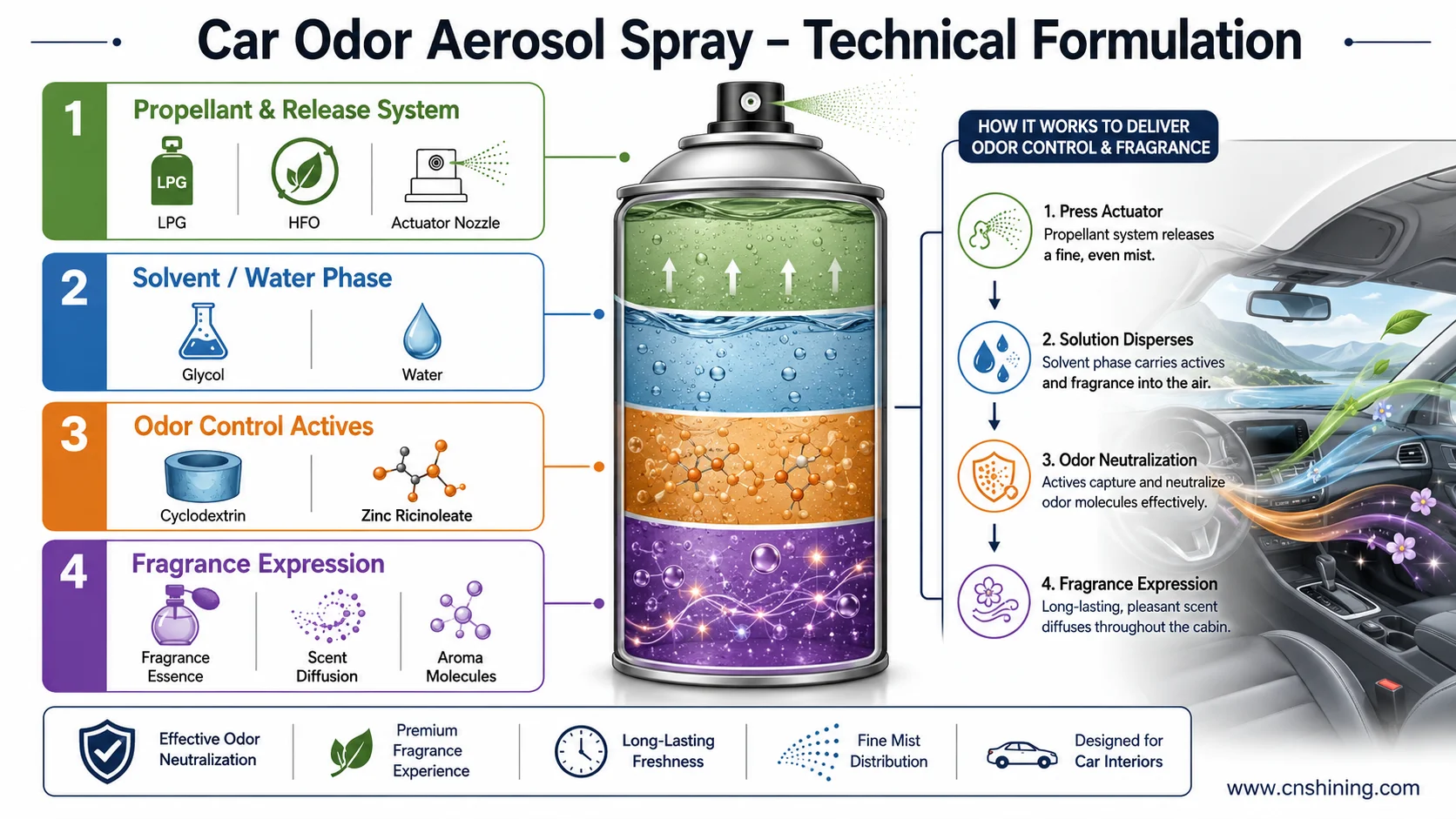
A practical car odor aerosol spray formula can be read as four layers:
- Propellant and release layer: LPG, HFO, compressed gas or other systems depending on region and VOC target.
- Solvent / continuous phase: water, ethanol, glycol or mixed systems.
- Odor-control active layer: glycol, cyclodextrin, zinc ricinoleate, MOC or other neutralizing chemistry.
- Fragrance layer: first impression, consumer identity and residual scent.
| Function | Representative Ingredient | Publicly Visible Window | Engineering Concern |
|---|---|---|---|
| Fragrance masking | Perfume blend, low-threshold odorants | Some MOC patents discuss very low dosage in fragranced systems | Too much fragrance causes headache, harshness and low-quality perception |
| Air sanitizer narrative | Triethylene glycol, propylene glycol | Ozium label: TEG 4.4%, PG 4.4% | Claims must stay inside approved labeling and evidence |
| Encapsulation | Cyclodextrin | Patent windows include water-rich systems with cyclodextrin | Clarity, sedimentation, valve blockage and storage stability |
| Neutralization | Zinc ricinoleate | Patent literature discusses solubilized zinc ricinoleate systems | Poor solubility; surfactant and solvent design are needed |
| Reactive MOC | Betaine, amino alcohols, aldehyde / ketone systems | Low active levels may still be patent-sensitive | Freedom-to-operate must be checked early |
| Adsorption support | Activated carbon or porous media | More common in bags and filters than aerosol cans | Saturation and poor immediate response |
Compatibility is usually the hidden problem. Cyclodextrin prefers water-rich systems. Zinc ricinoleate needs solubilization. Enzyme stories need stability. Citrus fragrance materials can stress internal coatings. A good formula on the bench can still fail through sediment, leakage, corrosion, poor mist quality or actuator clogging.
The EPA Ozium label, cyclodextrin odor neutralizer patent and zinc ricinoleate deodorization patent are useful starting points for technical review.
7. Regulation, VOC Limits and IP Watchpoints
| Market | Framework | Development Meaning |
|---|---|---|
| United States | TSCA, OSHA HazCom, FHSA, VOC rules, possible EPA claim control | Design against California VOC limits first when possible |
| Canada | CEPA and VOC concentration limits for certain products | Air freshener category limits are explicit and useful for low-VOC design |
| EU / EEA | REACH, CLP, Aerosol Dispenser Directive and ADR transport | Pressure safety, flammability labeling and packaging validation are tightly linked |
| Japan | CSCL, PRTR and GHS / SDS route | Good reference market for disciplined chemical management in Asia |
| Latin America / Middle East & Africa | Country-specific GHS, dangerous goods transport and consumer labeling | Distributor compliance capability matters more than complex claims |
For VOC work, the two most useful references are the California CARB Consumer Products Regulation and Canada’s VOC concentration limits for certain products. Canada’s air freshener limits distinguish single-phase aerosol, double-phase aerosol, liquid / pump and solid / semi-solid formats. That difference should be built into SKU planning.
Labeling must handle flammable aerosol warnings, pressurized container warnings, heat exposure, ventilation, eye contact, child access and transport classification. H222, H229 and UN1950 are not just legal codes. They affect how the user stores, ships and uses the product.
IP risk is concentrated in four areas: MOC combinations, zinc ricinoleate solubilization, HVAC-directed odor treatment and proprietary “new car scent” fragrance design. Low dosage does not remove patent risk. Some MOC claims discuss very low levels in fragranced systems.
Helpful references include malodor counteractant composition patents, vehicle HVAC deodorizer method patents and FHSA consumer hazard labeling guidance.
8. User Pain Points and Packaging Engineering Responses
User feedback in the source document points to the same issues again and again: too strong, smells like alcohol, short duration, headache, odor replacement, unclear instructions. These problems are not only formula problems. Packaging can solve a large part of them.
| User Pain Point | Packaging / Structure Response | Expected Effect |
|---|---|---|
| Too strong, headache | Metered valve or dual-mode actuator | Lower first-dose overload and better control |
| Alcohol-like burst | Finer mist actuator and better spray dispersion | Less local high concentration and fewer wet spots |
| Misuse of one-shot fogger | Front-label three-step icon: recirculate, wait, ventilate | Fewer complaints caused by wrong use |
| Accidental spray or leakage | Locking overcap, visible safety position, transport-safe actuator | Lower shipping and opening risk |
| Can falls during fogging | Low center of gravity, anti-slip base, cup-holder-aware diameter | More stable release process |
| Internal coating compatibility | Coating selected for ethanol, citrus oil and high-fragrance systems | Lower corrosion, leakage and odor drift risk |
| Short scent duration | Separate strong fogger and low-dose maintenance spray | Better repeat-use logic without overloading a single SKU |
| Counterfeit or channel confusion | Readable batch code, tamper-evident ring, traceable QR code | Improved e-commerce trust and complaint tracking |
The highest-value actions are often basic: metered valve, clear actuator design, safety overcap, stable can shape and readable instructions. They cost less than a full formula rebuild and can reduce user error, transport issues and bad reviews.
9. Shining Packaging Components for Car Odor Aerosol Spray
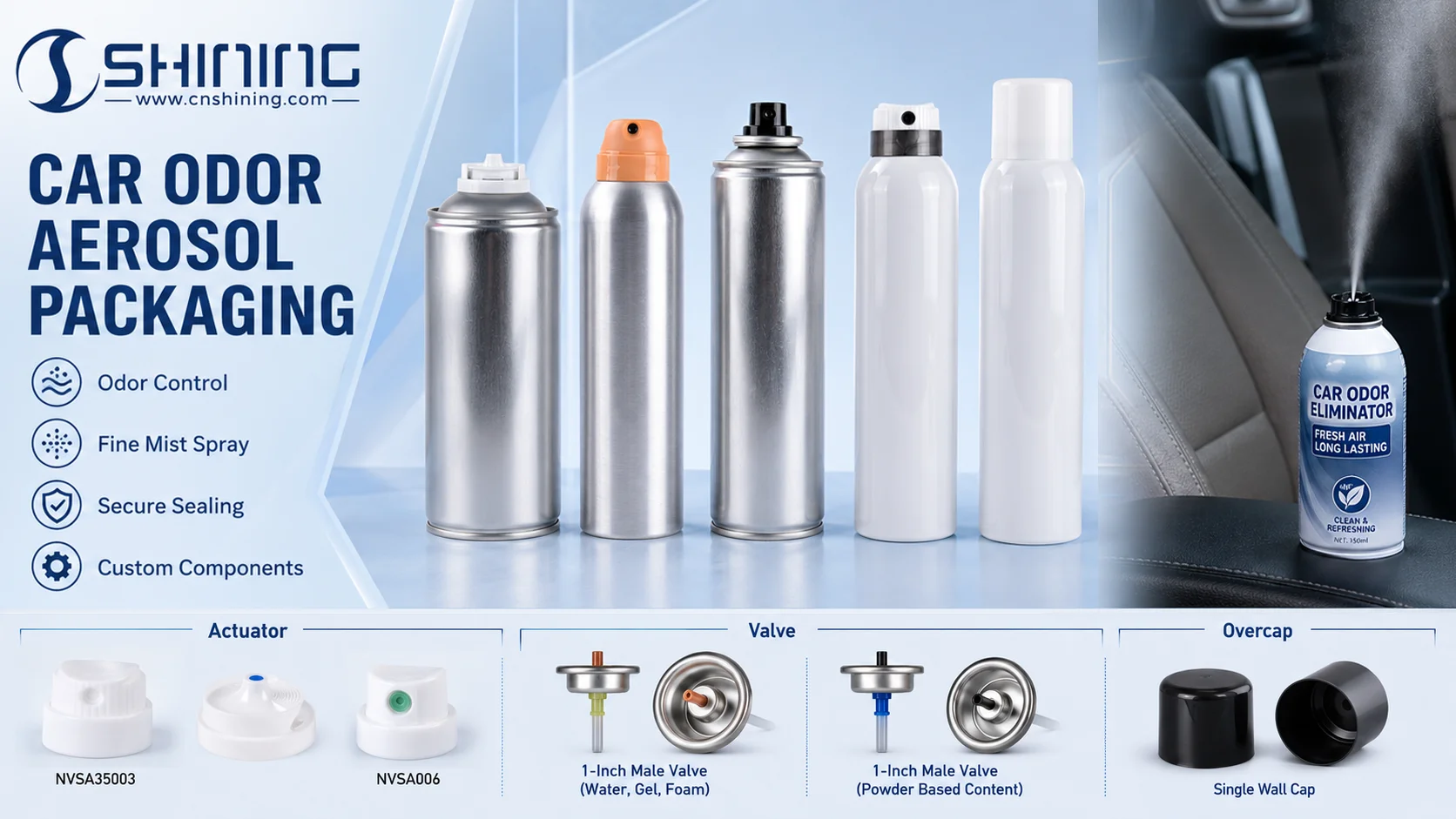
For this product class, Shining Packaging’s relevant scope sits in three parts: actuators, aerosol cans and valves. These parts decide how the formula leaves the can, how stable the package is during storage, and how much tolerance the user has during operation.
The actuator is not only a button. For car odor aerosol spray, it controls spray angle, droplet feel, finger force and accidental release risk. A wide, consistent mist is usually better for cabin treatment than a harsh jet. For one-shot foggers, the actuator must lock reliably and avoid partial activation during transport.
The aerosol can must match the formulation. Ethanol, citrus fragrance materials, glycol systems and high fragrance load can all stress internal coatings. Can diameter and height also affect the fogger process. A short, stable can reduces the chance of tipping over when placed on the vehicle floor.
The valve controls sealing, flow and dose repeatability. For daily-use car interior odor remover sprays, metering can reduce “too much fragrance” complaints. For total-release foggers, valve flow must support full discharge within the designed treatment window. This is where packaging engineering and formulation work must be tested together, not after each other.
This section can naturally use your uploaded product photo when available. The best image would show the actuator, valve and can as a functional system, not as isolated parts. That matches how buyers and engineers evaluate car odor aerosol spray packaging.
10. Technical Trend: Low VOC, Dry Feel and Controlled Release
The market direction is clear: users want real odor reduction, but they do not want the product to dominate the cabin. That pushes development toward lower VOC, lower irritation, dry-feel spray, controlled dose and clearer instructions.
Low-GWP propellants and better propellant choices are moving from concept to practical use. At the same time, traditional metal aerosol packaging remains strong because steel and aluminum cans are recyclable and already supported by mature filling infrastructure.
Smart diffusers and refillable systems are changing consumer expectations. Even if a traditional aerosol can is used, users now expect the release to feel controlled. That means metered aerosol valves, lighter fragrance profiles and safer overcaps deserve more attention than they received in older car air freshener projects.
European aerosol production data from SPRAY / FEA 2024 aerosol figures shows steel and aluminum remain the main aerosol container materials, while automotive / industrial aerosol is a visible production segment.
11. Conclusion
A strong car odor aerosol spray is built as a system. The formula must handle odor chemistry. The propellant and VOC window must fit the target market. The valve and actuator must control dose and spray quality. The can and internal coating must survive the solvent and fragrance system. The label must stop misuse before it happens.
The practical product split is also clear. A whole-car one-shot fogger fits smoke, pet, used-car, taxi and food odor scenarios. A lighter controlled spray fits daily maintenance. Trying to make one SKU solve both jobs usually creates either weak odor removal or excessive scent load.
For development teams, the better question is not “Which fragrance smells stronger?” It is: Can this product remove or reduce the target odor, pass regional VOC and transport rules, discharge safely, and leave the cabin comfortable after ventilation? That is where the category is won or lost.
12. FAQ: Car Odor Aerosol Spray
A car odor aerosol spray is a pressurized package-and-release system. It uses an aerosol can, propellant, valve and actuator to atomize a liquid formula into droplets. In car odor use, the system must work inside a small cabin with fabric, plastic and HVAC ducts, so dose control and spray pattern matter as much as fragrance.
A hand spray is used locally on mats, seats or cabin air. A one-shot fogger releases the full contents after activation and uses HVAC recirculation to move droplets through the interior and ducts. It gives broader coverage, but it also carries higher over-scenting and misuse risk if the user skips ventilation.
It depends on the formulation. Some products mainly mask odor with fragrance. More technical formulas may use cyclodextrin encapsulation, zinc ricinoleate neutralization, glycol systems or malodor counteractants. Even then, source removal matters. Wet fabric, smoke residue or a dirty evaporator can keep producing odor after spraying.
The usual reasons are high fragrance load, large first dose, poor mist distribution or insufficient ventilation after use. In a car cabin, the air volume is small and surfaces absorb fragrance unevenly. A metered valve, softer actuator spray pattern and clear use instructions can reduce the “too strong” complaint without changing the whole formula.
Recirculation helps carry aerosol droplets through the ventilation path, across the headliner area and into hard-to-reach cabin zones. Without airflow, the fog mostly settles near the can. The process still requires an empty vehicle and later ventilation, because the goal is treated coverage, not occupant exposure to concentrated mist.
The actuator controls spray feel, angle and accidental release. The valve controls flow, sealing and dose. The can controls pressure safety, stability and coating compatibility. For car odor products, these parts are not cosmetic. They directly affect mist quality, leakage risk, discharge time, user comfort and complaint rate.
VOC rules can restrict solvent and propellant choices, especially in markets such as California and Canada. A formula that works technically may still fail if it exceeds category limits. Product teams should define whether the SKU is single-phase aerosol, double-phase aerosol, pump spray or total-release aerosol before finalizing the formulation.
No. Ozone machines generate ozone gas and require stricter vacancy and safety control. Aerosol foggers release a packaged chemical formula through a valve and actuator. Ozone may handle heavy odor under controlled professional use, but it carries health concerns in occupied spaces and should not be treated as the same consumer product type.
Common causes include sediment, incompatible actives, poor solubilization, resin or fragrance instability, and mismatch between formula viscosity and valve design. Cyclodextrin, zinc ricinoleate systems and high fragrance loads need careful stability testing. Low-temperature storage, heat aging and full-discharge testing should be done before launch.
A practical structure is two lines: a whole-car fogger for strong odors and a lighter controlled spray for daily maintenance. This avoids forcing one formula to do opposite jobs. The fogger can focus on full-cabin treatment, while the daily spray can use metered delivery, milder fragrance and lower overuse risk.