
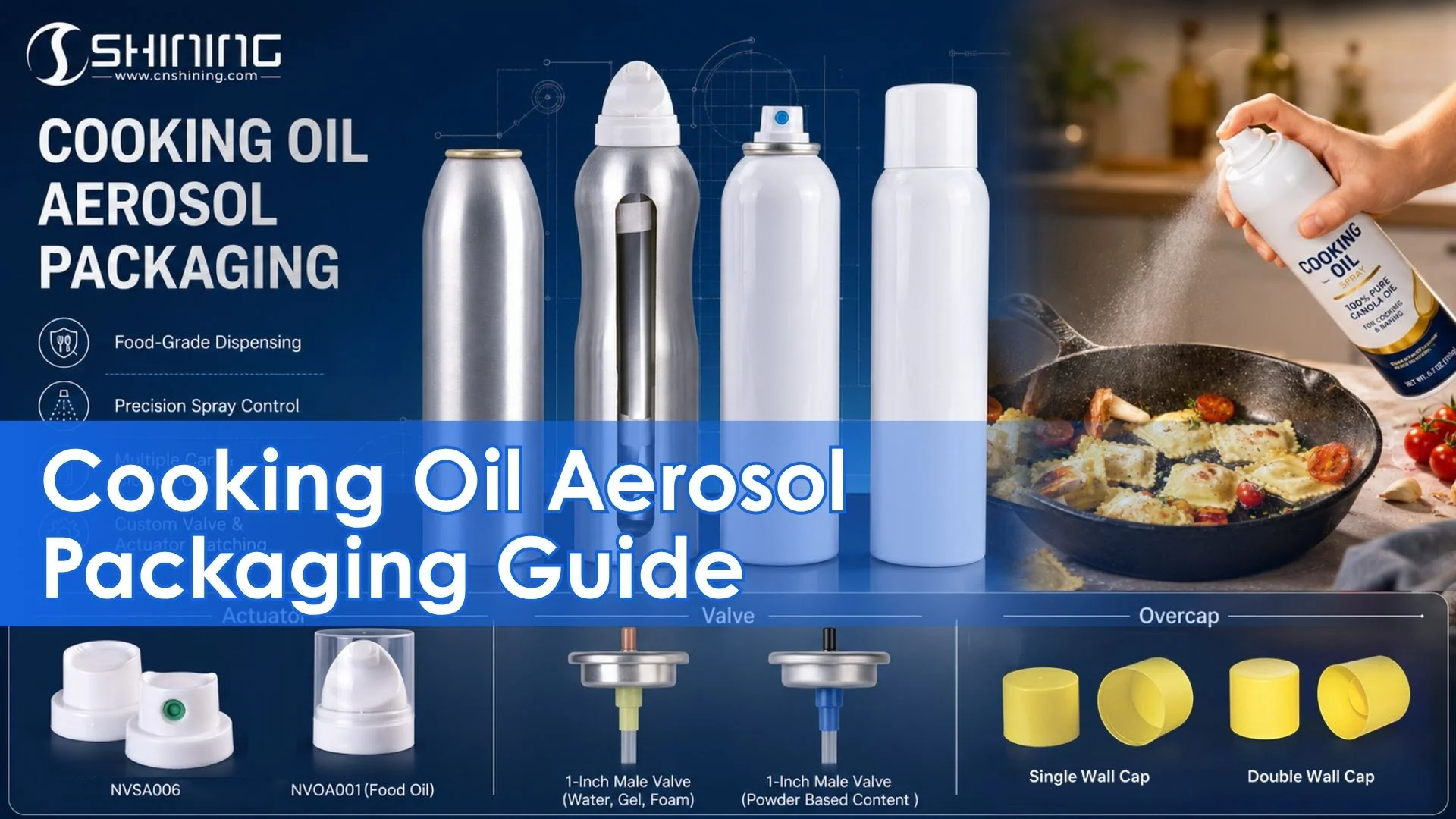
Cooking oil aerosol spray is a pressure-driven packaging problem before it is a cooking-oil problem. The product normally places edible oil or pan-release formulation in a pressurized container, then atomizes it through a valve, actuator and spray orifice. The user sees a thin oil film on a pan. The engineer sees propellant choice, viscosity, valve geometry, food-contact coatings, clogging risk and transport safety.
In legal language, an aerosol cooking spray under U.S. EPA consumer product rules is not the same as a pump spray. Retail shelves may group propellant-free oil sprayers, non-aerosol oil sprays and classic cooking aerosol cans together, but the compliance load is different. That distinction matters for VOC limits, dangerous goods handling, warning labels and package testing.
1. Definition, Structure and Working Principle
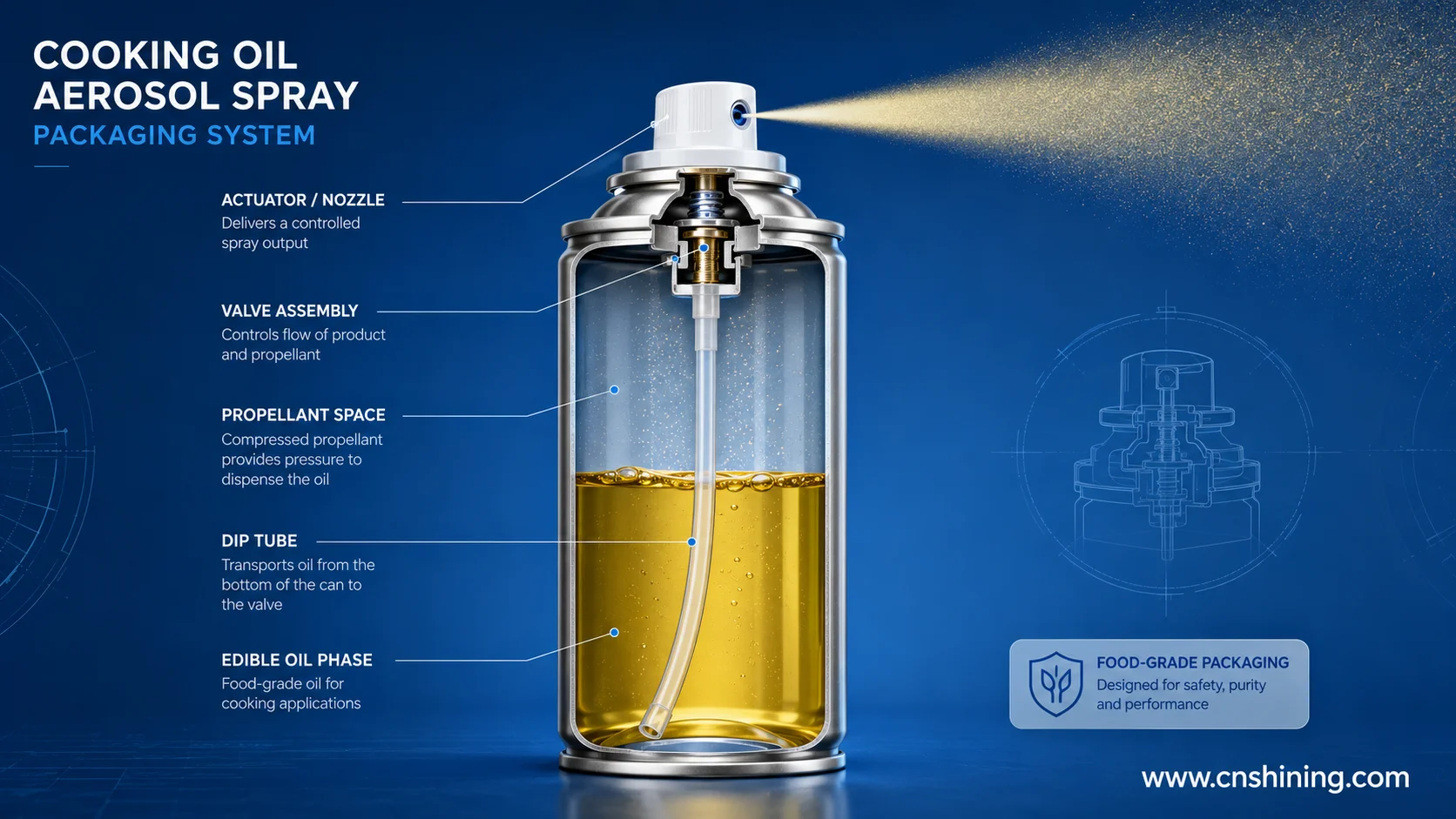
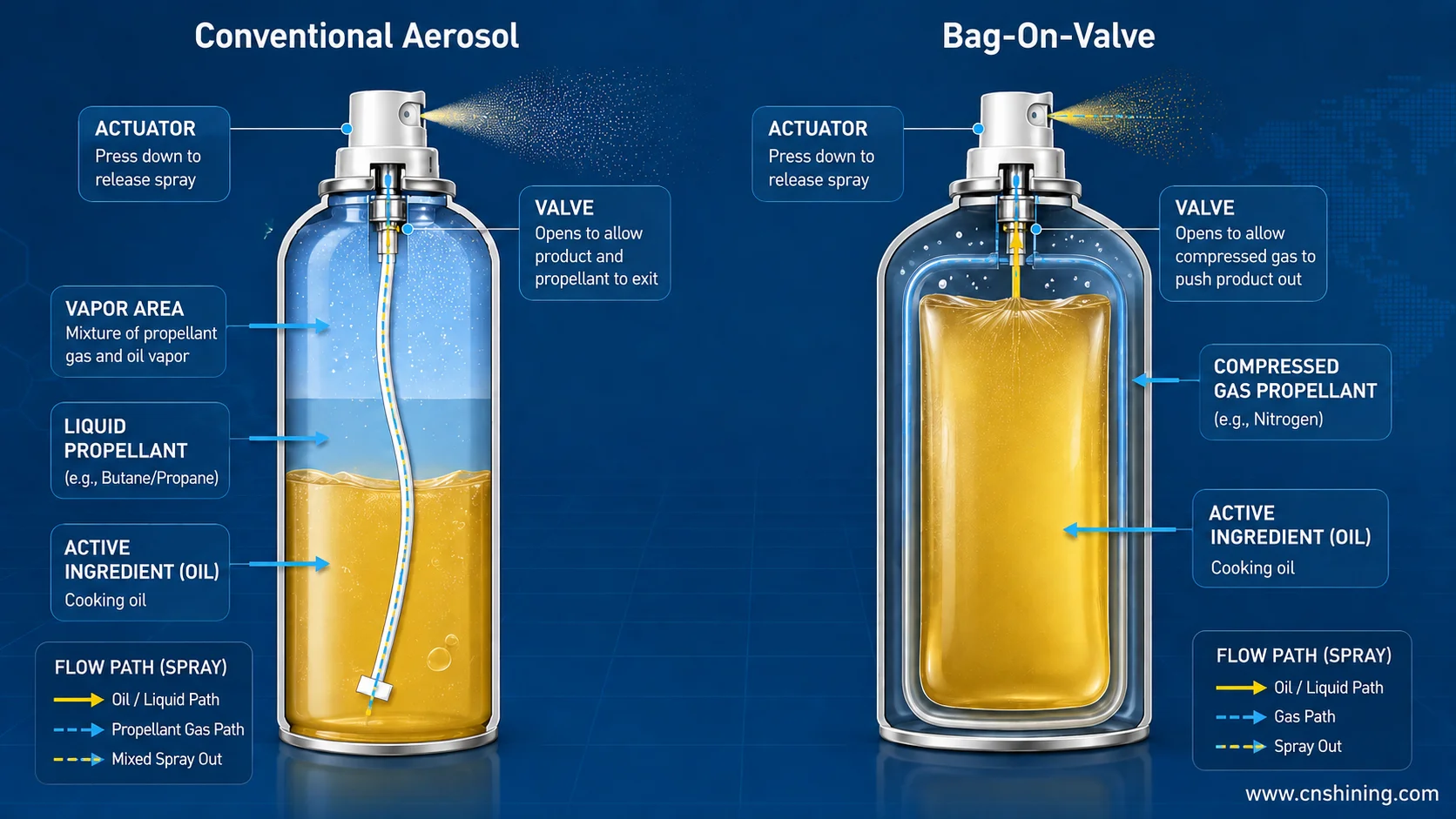
From a packaging engineering view, cooking oil spray has three common structures. The first is the classic one-chamber aerosol can, where oil phase and propellant stay in the same container. When the actuator is pressed, the valve opens, liquid passes through the stem, body, insert and orifice, and pressure drop helps break the liquid into droplets.
The second structure is Bag-on-Valve. In BOV, the product is held inside a bag and the driving gas stays outside the bag. This makes the dispensed product closer to “pure product” and can support more stable end-of-life spray and 360-degree use. The third structure is propellant-free mechanical or air-pressure packaging. It can support “100% oil” positioning, but its spray pattern depends heavily on hand force and nozzle maintenance.
| Structure | How it works | Packaging implication |
|---|---|---|
| Classic aerosol can | Oil and propellant share one pressurized container. | Good atomization, but higher pressure, flammability and VOC management burden. |
| Bag-on-Valve | Oil is inside the bag; compressed gas is outside. | Better product-propellant separation and stronger 360-degree use potential. |
| Propellant-free sprayer | Mechanical pressure or trigger action pushes oil through a nozzle. | Cleaner label story, but weaker spray consistency under real kitchen use. |
2. Valves, Propellants and Spray Pattern Control
The user calls it “spray quality.” In the factory, it is a controlled relationship between valve, actuator, insert, mechanical break-up geometry, dip tube, stem slot, propellant pressure, oil viscosity and surface tension.
| Dimension | Typical options | Function | Commercial meaning |
|---|---|---|---|
| Valve structure | Male, female, tilt-action, BOV | Defines actuation, sealing, cleaning and 360-degree potential. | Directly affects clogging rate, assembly cost and user feel. |
| Spray pattern | Full round, fan, stream, foam | Controls coverage area and directionality. | Fan spray suits pans; stream suits corners or targeted oiling. |
| Propellant | Propane, butane, isobutane, N2O, CO2, air, N2 | Provides delivery energy and atomization support. | Hydrocarbons atomize well but raise flammability and VOC pressure. |
| Insert and orifice | Different orifice diameters, land lengths and counter bores | Fine-tunes spray rate, droplet size and spray angle. | A small component can create a visible brand-level spray difference. |
| Locking system | Twist-to-lock, hoodless lockable actuator | Reduces accidental discharge and leakage. | Useful for e-commerce, outdoor cooking and air-fryer users. |
Actuator design is moving from simple push buttons to controlled dispensing parts. For example, Dual-spray actuator supports two spray outputs in one solution. Twist-to-lock aerosol actuator show why transport safety and accidental actuation are now part of the dispensing discussion.
3. Product Value and Comparison With Alternatives
The value of cooking oil aerosol spray is not simply “healthier oil.” The practical value is controlled dosage, thin-film coverage, reduced sticking, faster preparation and easier cleanup. These claims only hold when the spray remains stable and the package does not leak, clog or leave gummy residue.
| Solution | Advantages | Weak points | Typical use |
|---|---|---|---|
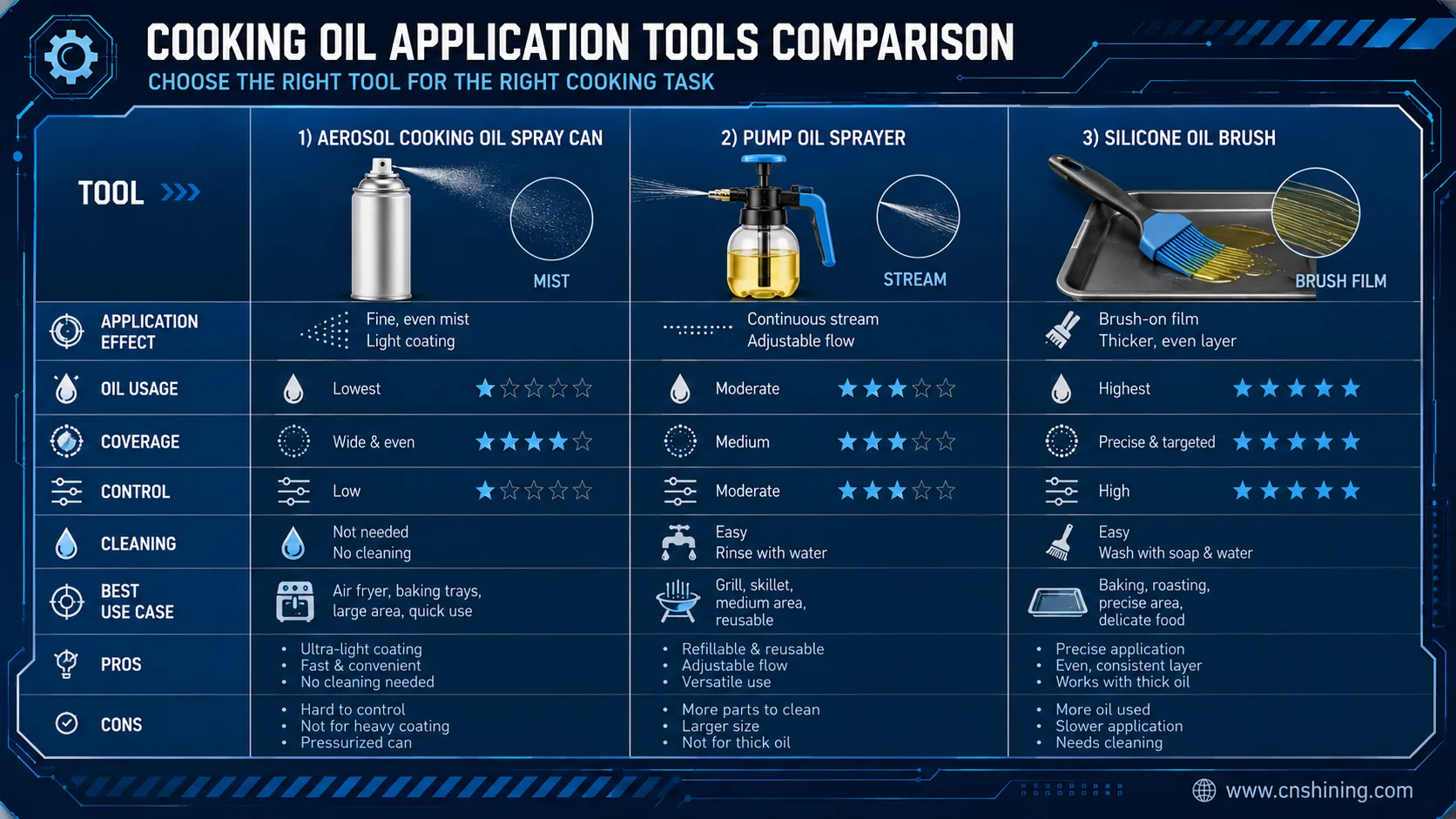
| Classic aerosol cooking spray | Uniform coverage, one-hand use, thin oil film, fast pan coating. | Pressure vessel, VOC, flammability, clogging and overheating concerns. | Home cooking, baking trays, air fryers, chain kitchens. |
| Liquid pump oil sprayer | Lower packaging complexity, refillable, no propellant. | Spray often shifts from mist to stream; cleaning and leakage are common. | DIY home use and low-frequency oiling. |
| Brush or silicone brush | No pressure container, intuitive control. | Uneven film, higher oil use, slower operation, hygiene control issues. | Small-batch glazing, barbecue sauces, viscous coatings. |
4. Formulation Systems and Technical Terms
Formulation windows in public patents or labels are not universal formulas. They show feasible ranges. Commercial formulas still need adjustment around oil type, spray target, valve compatibility, legal market, cost and shelf life.
| Formula type | Common components | Visible range or style | Function |
|---|---|---|---|
| Classic non-stick aerosol formula | Oil, lecithin, dimethylpolysiloxane, propellant | Vegetable oil plus lecithin and hydrocarbon propellant is common in older patent and label examples. | Forms anti-stick film, improves wetting and supports stable spray. |
| Baking release spray | Oil, lecithin, flour or starch, anti-caking system | Aerosol cookware lubricant patent examples include flour or starch with fumed silica. | Improves release from molds, but may carbonize in high-heat pan use. |
| Propellant-free pure oil spray | Olive oil, avocado oil or other edible oil | Often positioned as 100% oil with no propellant or emulsifier. | Good clean-label fit, but requires a robust mechanical nozzle. |
| Water-based or emulsion pan release | Water, oil, lecithin, preservative when needed | Pan spray formulation patent examples show water and oil windows for release systems. | Can reduce oil load, but compatibility and preservation work increase. |
| Composite patented aerosol formula | Oil, liquid or powdered lecithin, water or alcohol, antioxidant, preservative, propellant | CN101543281A discloses several cooking spray formulation ranges. | Shows technical feasibility rather than a mainstream industry standard. |
Key formulation challenges
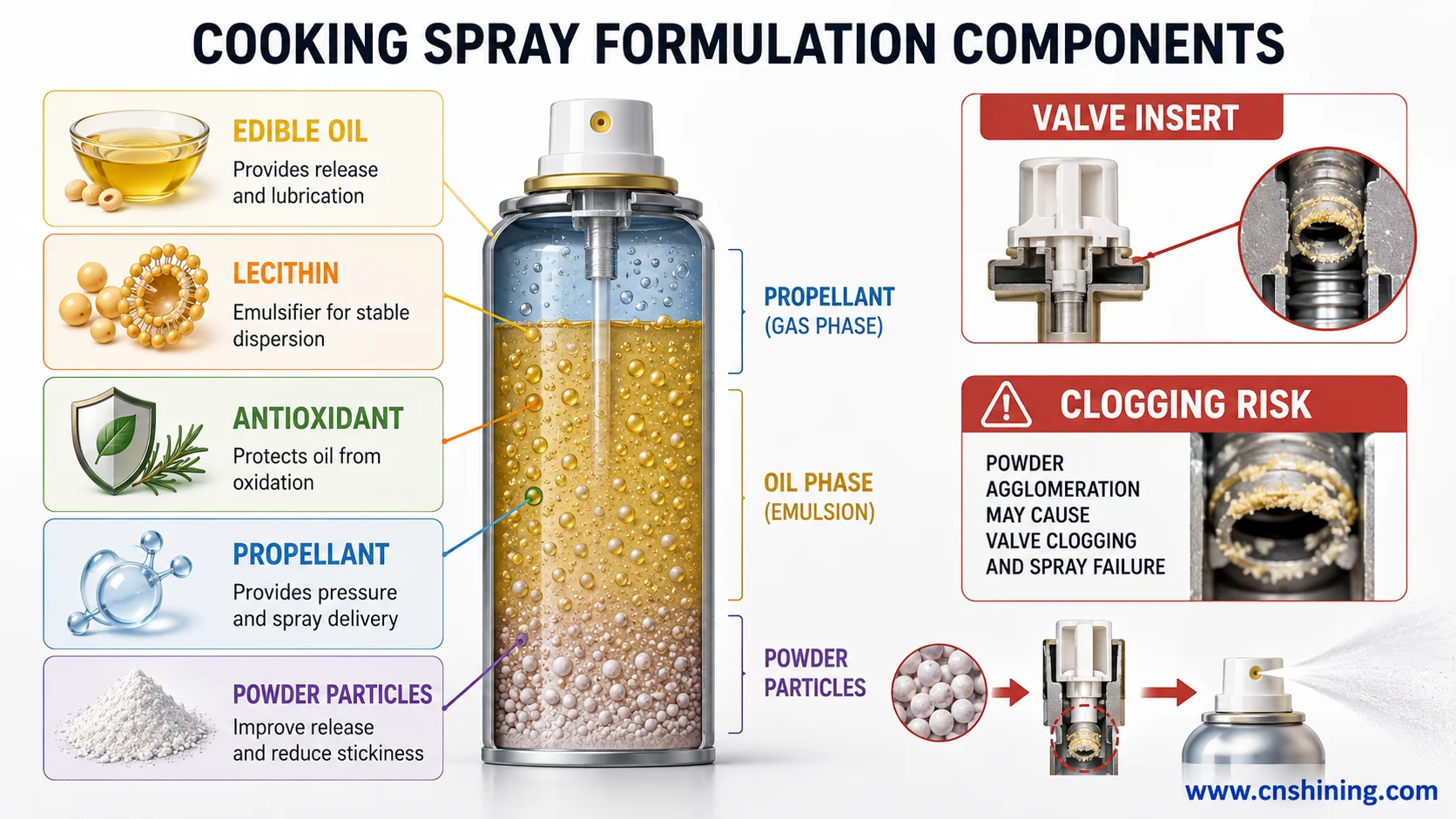
Oxidation stability is the first problem. Vegetable oils, especially high-PUFA oils, can oxidize. Tocopherols, rosemary extract and other antioxidants may help, but performance depends on the oil system and interfacial behavior.
Valve clogging is the second problem. Oil residue, powders, high-viscosity oils and poorly matched inserts can turn mist into stream. Baking-release formulas with flour or starch need extra attention because packing and valve blockage are predictable risks.
Internal coating compatibility is the third problem. A cooking spray can must protect food quality and protect the metal substrate. The food-contact coating route should be checked under actual oil, additive, heat and storage conditions.
5. Regulatory and Compliance Framework
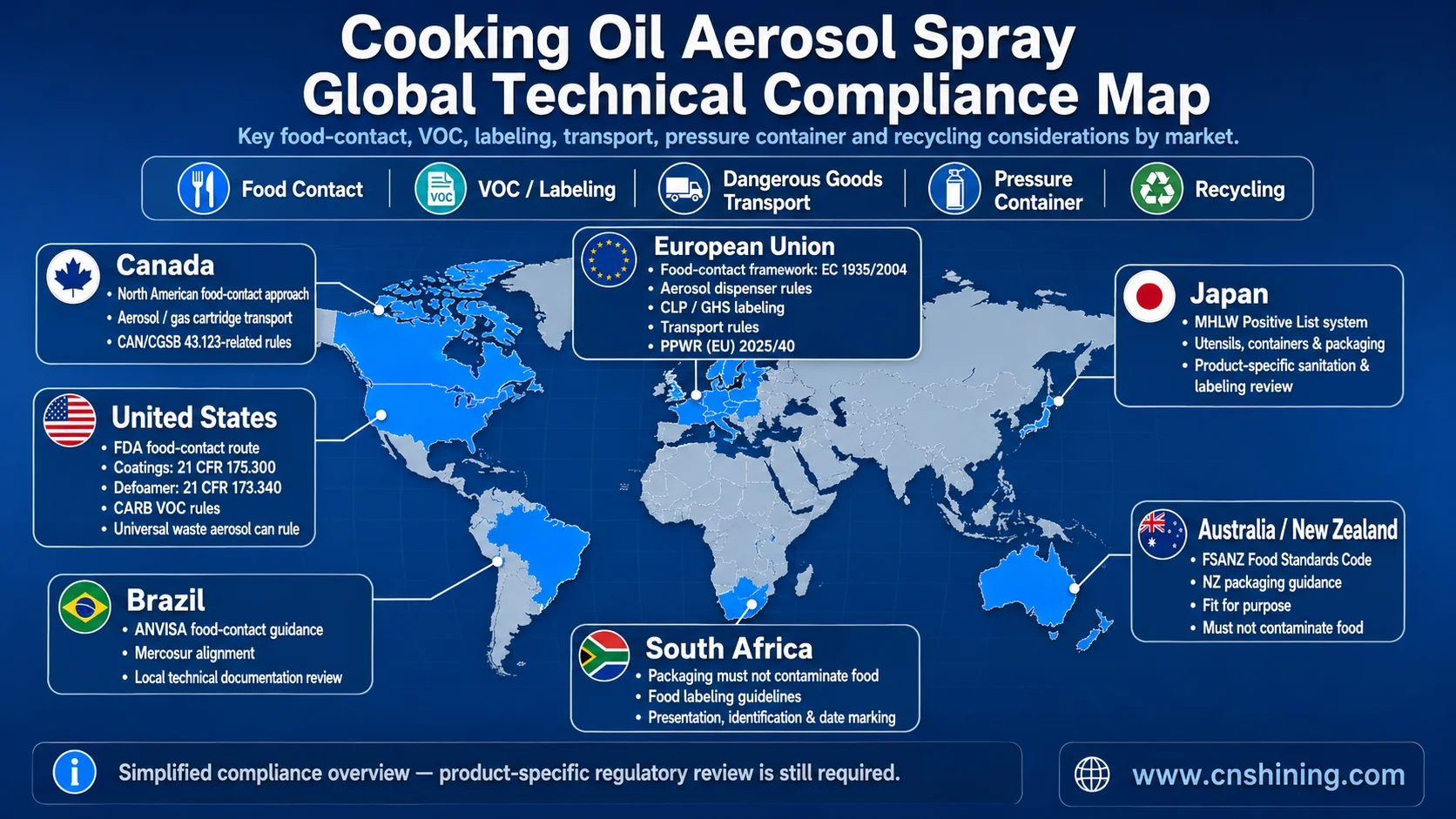
Cooking oil aerosol spray crosses five compliance layers: food-contact materials, food additives or formulation legality, labeling, VOC or environmental rules, and pressure vessel / dangerous goods transport. The hard part is the overlap. A product can be food, a consumer product, a pressurized container and a transport-regulated article at the same time.
| Market | Food-contact / formulation focus | Label, VOC and pressure focus |
|---|---|---|
| United States | FDA food-contact status should be checked through the FDA food-contact material route. Resinous coatings are covered under 21 CFR 175.300. Dimethylpolysiloxane as a defoaming agent is addressed under 21 CFR 173.340. | CARB lists VOC requirements in the Consumer Products Regulation. Aerosol cans are also addressed in the U.S. universal waste aerosol can rule. |
| Canada | Food-contact logic is close to North American practice. | Transport Canada states that aerosol containers and gas cartridges must follow CAN/CGSB 43.123-related transport requirements. |
| European Union | Regulation (EC) No 1935/2004 is the broad food-contact material framework. | Aerosol dispenser rules, CLP/GHS, transport rules and the Packaging and Packaging Waste Regulation (EU) 2025/40 all affect package design and labeling. |
| Japan | MHLW has implemented a Positive List system for utensils, containers and packaging through its utensils, containers and packaging page. | Food sanitation and labeling rules need product-specific review. |
| Australia / New Zealand | FSANZ explains the Food Standards Code through its Food Standards Code legislation page. New Zealand also provides food packaging rules and guidance. | Fit-for-purpose evidence matters. Packaging must not contaminate food. |
| Brazil | ANVISA provides detailed guidance in its food-contact materials Q&A. | Mercosur alignment, packaging principles and technical documentation need local review. |
| South Africa | Packaging must not contaminate food. | Label presentation, identification and date marking are addressed in the South African food labelling guidelines. |
6. Top 10 Cooking Oil Spray Brands
| Brand | Main market | Common size | Observed price band | Technical / market comment |
|---|---|---|---|---|
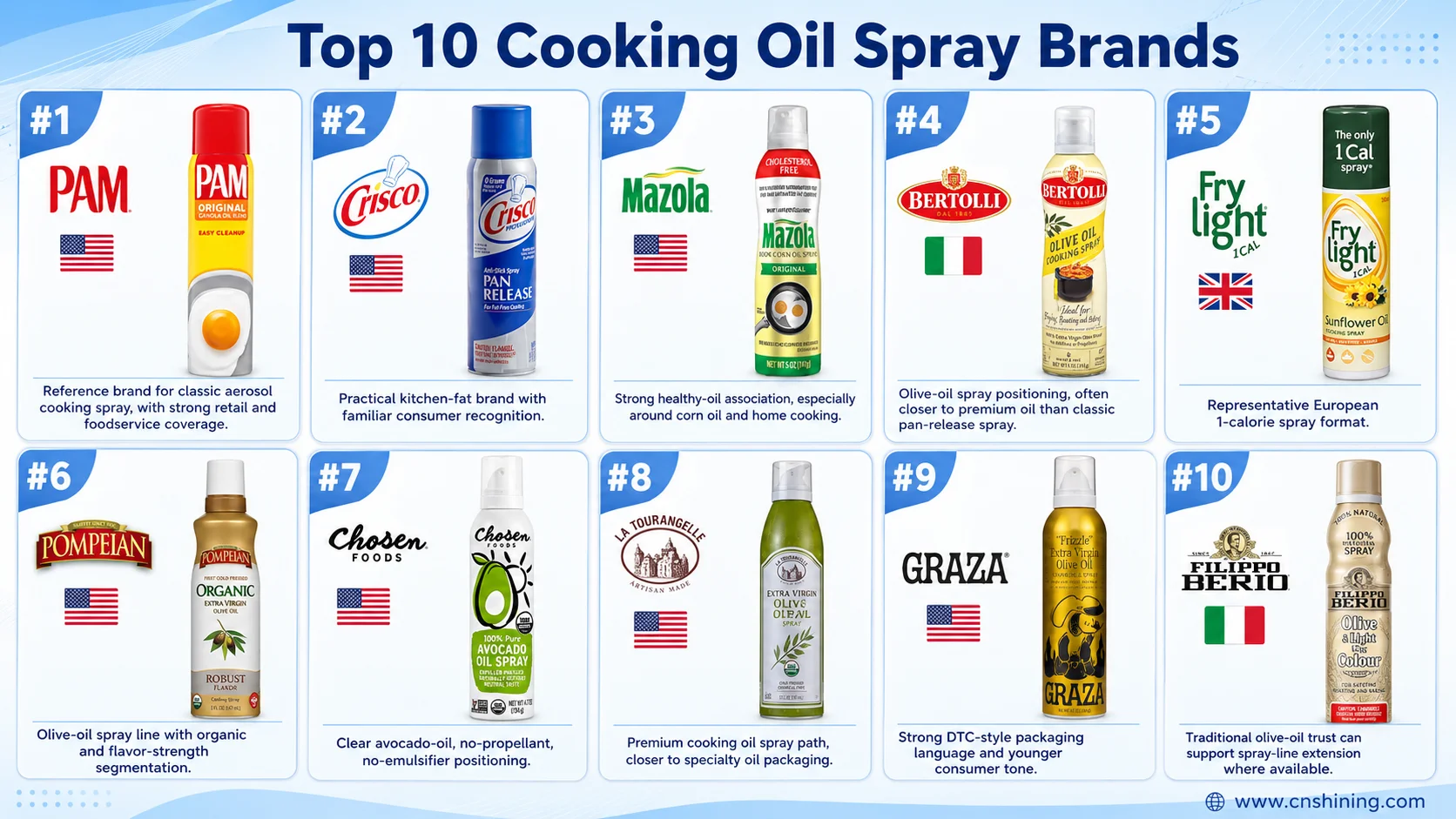
| PAM | United States | 5 oz, 6 oz, 10 oz, 12 oz, foodservice cans | US$3.4–6 | Reference brand for classic aerosol cooking spray, with strong retail and foodservice coverage. |
| Crisco | United States | 6 oz | US$8.87 | Practical kitchen-fat brand with familiar consumer recognition. |
| Mazola | United States | Strong “healthy oil” association, especially around corn oil and home cooking. | ||
| Bertolli | Italy | 4.9 fl oz / 200 ml | US$3.34 | Olive-oil spray positioning, often closer to premium oil than classic pan-release spray. |
| Frylight | United Kingdom | 190 ml | £2.75–4.50 | Representative European 1-calorie spray format. |
| Pompeian | United States | 5 fl oz | US$3.88 | Olive-oil spray line with organic and flavor-strength segmentation. |
| Chosen Foods | United States | 4.7 oz, 13.5 oz | US$6.43 to US$12.47 | Clear avocado-oil, no-propellant, no-emulsifier positioning. |
| La Tourangelle | United States | 5 fl oz | US$5.68 | Premium cooking oil spray path, closer to specialty oil packaging. |
| Graza | United States | 5 fl oz | US$6.47 to US$7 | Strong DTC-style packaging language and younger consumer tone. |
| Filippo Berio | Italy | 200 ml | Traditional olive-oil trust can support spray-line extension where available. |
7. Packaging Failure Modes and Improvement Direction
User complaints are not random. They map back to hardware and information design. The common problems are clogged spray heads, leakage, unstable fan pattern, gummy residue, transport damage and weak heat-safety warnings.
| User pain point | Likely packaging root cause | Practical design response |
|---|---|---|
| Spray head clogging | Oil residue in orifice, dip tube or cap; high-viscosity oil; powder in release formula. | Use oil-specific insert, removable or cleanable actuator, anti-clog flow path and clear cleaning pictogram. |
| Mist turns into stream | Pressure decay, nozzle contamination or weak mechanical pump stability. | Define separate fan and stream functions, or improve actuator consistency and pre-pressure feedback. |
| Leakage and shipping damage | Weak closure, poor seal, glass shoulder breakage, uncontrolled shipping orientation. | Use lockable actuator, overcap retention, better gasket system and e-commerce transport testing. |
| Sticky residue on cookware | Lecithin, antifoam or flavor components reacting under high heat; excessive dose. | Separate pure-oil line from pan-release line; label use surfaces and temperature limits clearly. |
| Heat safety concerns | Can stored near stove, warning text too small, venting and pressure design not understood by users. | Use stronger front-panel heat pictograms, reliable pressure-relief design and distance-from-heat graphics. |
8. Product Fit: Shining Packaging Actuators, Cans and Valves
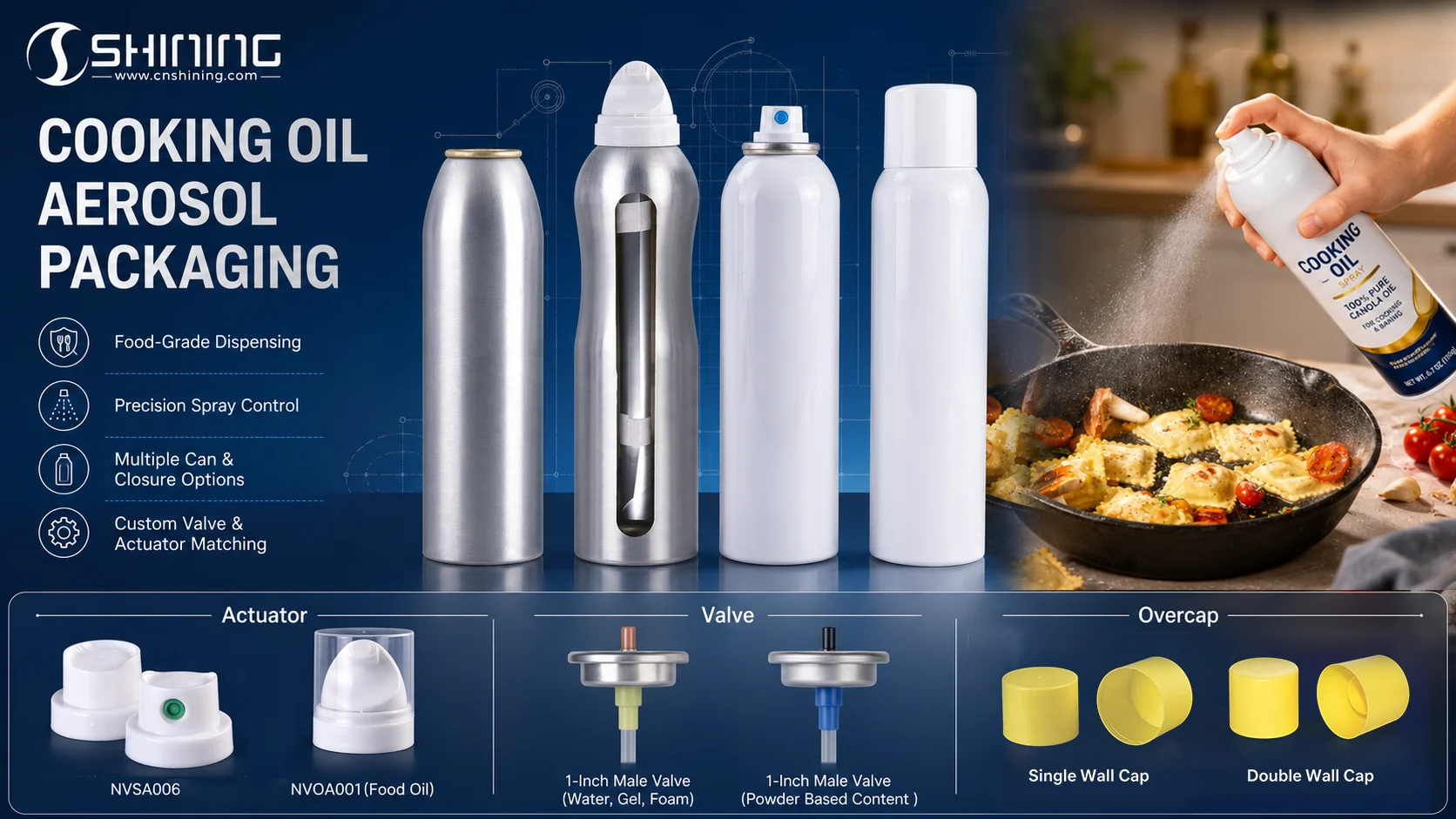
For this category, Shining Packaging should be discussed at the component level: actuator, aerosol can and valve. These parts decide whether the oil forms a controlled film or leaves the user with a blocked nozzle and an oily cap. A cooking oil aerosol spray package needs a stable can body, food-contact compatible internal surface, oil-suitable valve path and an actuator that can keep the fan pattern repeatable.
The natural development direction is not to make the package look more complex. It is to reduce avoidable failure: accidental actuation during transport, weak spray after storage, residue accumulation around the button, poor grip near a hot pan, and warnings that users do not notice. In practical terms, that means testing the actuator and valve with the real oil blend, not only with a low-viscosity lab liquid.
9. Conclusion
Cooking oil aerosol spray succeeds when the package turns a difficult liquid into a stable, repeatable kitchen action. The key question is simple: can the product still spray a controlled film after storage, shipping, partial use, exposure to oily fingers and normal kitchen neglect? If the answer is no, the oil story will not rescue the SKU.
The strongest technical direction is clear. Use the right valve and actuator for oil viscosity, decide early between classic aerosol, BOV and propellant-free structures, validate internal coating compatibility, make heat and cleaning instructions visible, and separate pure-oil products from heavy pan-release formulas. That is where this category is moving: less generic aerosol hardware, more oil-specific packaging engineering.
10. FAQ: Cooking Oil Aerosol Spray Packaging
No. A cooking oil aerosol spray is normally a pressurized system, while a pump oil spray uses mechanical action and is not treated the same way under many regulatory definitions. This difference affects VOC review, pressure-container rules, transport classification and warning labels. In retail, both may compete on the same shelf, but packaging validation should not treat them as equivalent.
Clogging usually comes from oil residue, high viscosity, powders in baking-release formulas, or poor matching between the formula and valve insert. Residue can build inside the orifice, stem or cap area. Once the flow path changes, a fine fan spray may become a stream. Cleanable actuators, oil-specific inserts and clear use instructions reduce this risk.
Bag-on-Valve places the oil inside a flexible bag while the driving gas remains outside the bag. This separates product from propellant and can support more stable dispensing, better use at different angles and cleaner product-positioning language. It does not remove all compliance work, but it changes the formulation and dispensing design space.
Fan spray is usually better for coating pans, baking trays and air-fryer baskets because it spreads oil over a wider area. Stream spray is useful for corners or targeted application, but it can feel like a failure when the user expects mist. Some actuator concepts use dual spray modes to separate wide-area coating from focused dosing.
Sticky residue can come from lecithin, antifoam agents, flavor components or excessive dose under high heat. These materials can improve release performance, but they may react or polymerize on hot surfaces. A pure-oil spray and a baking-release spray should not be positioned as the same tool. Labeling should state suitable cookware and temperature limits.
Hydrocarbon propellants such as propane, butane or isobutane are technically attractive because they provide strong atomization and cost efficiency. The trade-off is flammability, VOC pressure and more demanding warning requirements. Compressed air, nitrogen, carbon dioxide or BOV routes can support cleaner positioning, but they require different valve and spray tuning.
The package should be tested for spray rate, fan width, droplet consistency, clogging after storage, leakage, actuator locking, heat warning visibility, corrosion or coating compatibility, and performance near end of life. Testing only the fresh sample is not enough. Oil sprays often fail after partial use, temperature cycling or residue buildup.
Internal coating protects both the food product and the metal can. Cooking spray formulas may include oil, emulsifiers, antioxidants, flavors or release agents, so migration and corrosion behavior must be checked with the actual formula. BPA-NI and other alternative coating routes are becoming more common, but compatibility still needs product-specific validation.
Choose classic aerosol when uniform coverage, speed and thin-film performance are the main goals. Choose BOV when product-propellant separation, 360-degree use and stable dispensing are more valuable. Choose propellant-free spray when the main message is pure oil or no additives. Each route needs different hardware, label language and performance testing.
The most useful improvements are oil-specific valve inserts, lockable actuators, cleanable spray buttons, stable can geometry, food-contact compatible internal coatings and front-panel safety pictograms. These changes address real complaints: clogging, leakage, poor spray control, sticky residue and heat risk. More flavor variants will not fix weak dispensing hardware.